


19 August 2026
Many secondary school students in Bangladesh report practicing healthy habits but a new national study finds that stronger systems are needed around them. From formal health education and trained teachers to health services and school facilities
The findings come from the Situation Analysis Report on the Health Promoting Schools Programme in Bangladesh, published in July 2026 by theDirectorate of Secondary and Higher Education (DSHE), under theSecondary and Higher Education Divisionof theMinistry of Education. The Health Promoting Schools programme is implemented by DSHE and theNational Academy for Education Management (NAEM), with support from UNESCO.
A health-promoting school goes beyond teaching basic hygiene. Health and well-being should be reflected across lessons, teacher preparation, facilities, services, physical activity, mental and emotional support, leadership and community engagement
Healthy habits need stronger foundations
The study surveyed responses from458 students and 206teachers in 48 secondary schools across all eight administrative divisions of Bangladesh, alongside 24 focus-group discussions, 12 interviews with key officials and specialists and a review of policies, curricula and textbooks
One of the clearest findings is that students’ healthy practices appear stronger than their formal understanding of health
Students reported following many positive behaviours, but their overall health knowledge was assessed as poor. This suggests that children may be learning healthy habits from parents, teachers, public campaigns and everyday experience without always receiving the structured knowledge they need to understand why those behaviours matter or how to make informed decisions when they face more complex health issues.
The findings therefore point not to an absence of health awareness, but to an opportunity to build more consistent health education around practices that already exist
Teachers need more support to turn knowledge into learning
UNESCO
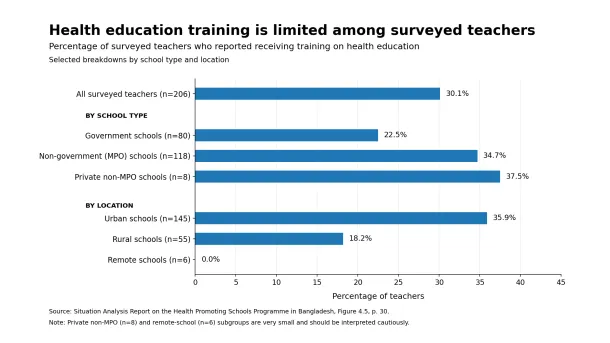
The study found that the teaching workforce was generally academically qualified, but health-specific preparation was much less common. Only around three in ten surveyed teachers had received training related to health education or student well-being, and training was particularly limited among teachers in government and rural schools
Where training had been provided, it was often short. This creates a practical challenge: teachers may be expected to guide students on issues ranging from hygiene and nutrition to mental and emotional well-being without always having sufficient preparation themselves
Health and hygiene also appeared to receive relatively little dedicated classroom attention. The report suggests that because these areas are not part of final examinations, they may be given less priority within an education system where examinations strongly influence classroom time and attention
Policy awareness presents a similar challenge. Many teachers were unfamiliar with relevant national provisions on school health, suggesting that policies and guidance do not always reach the people expected to apply them in classrooms
Health services differ between schools
Students in non-government schools were more likely than those in government schools to report access to clean and usable toilets, safe drinking water, anti-bullying measures and a separate health worker. The figures reflect students’ perceptions rather than physical inspections, but they suggest that access to basic health support differs across the schools surveyed
The figures are based on students’ perceptions rather than physical inspections of school facilities. Even so, the pattern suggests that access to basic health support is not experienced equally across the schools surveyed
Regular health check-ups were not routine for many students, and arrangements for responding to accidents were also not consistently reported
