


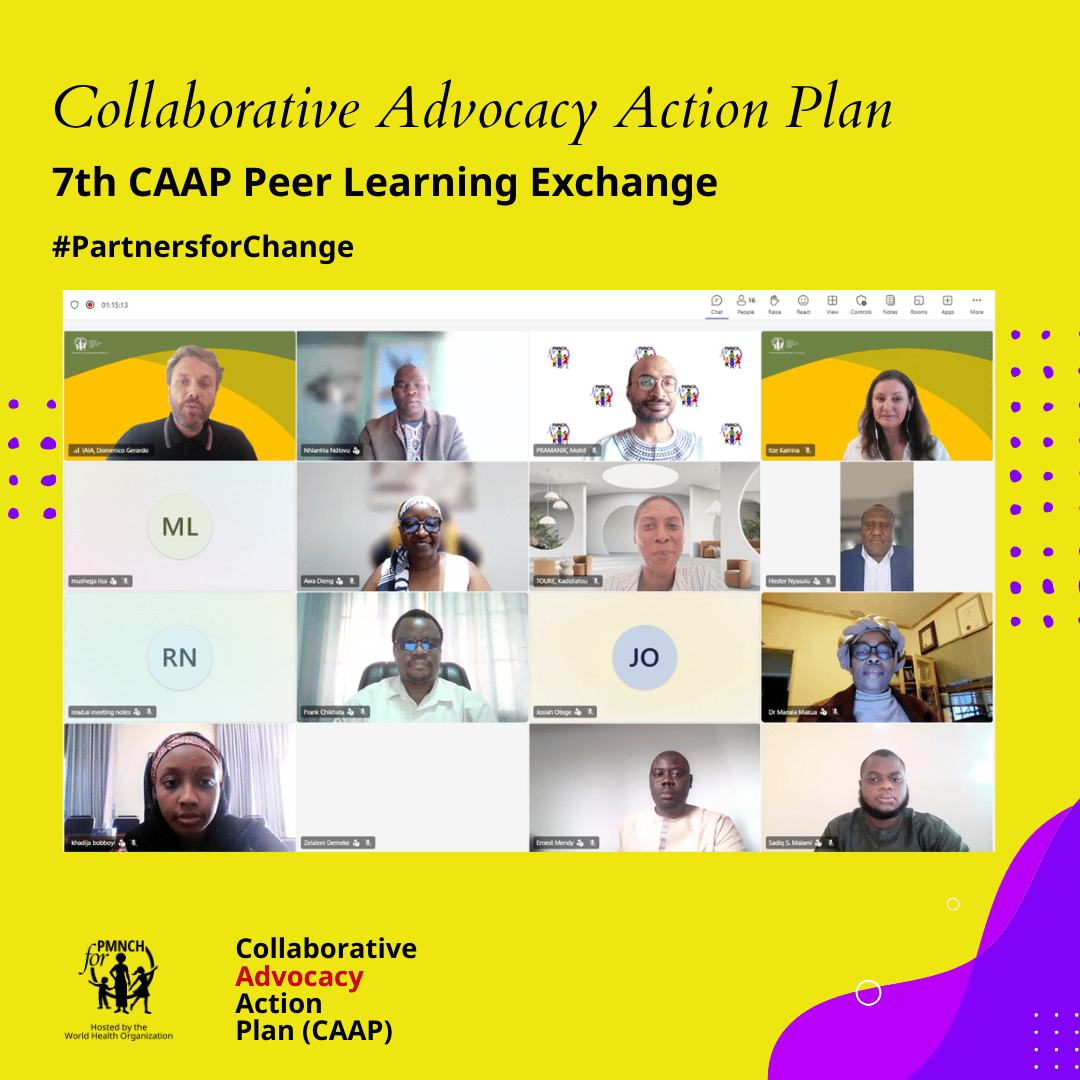
The 7th CAAP Peer Learning Exchange brought CAAP coordinating partners from ten sub-Saharan African countries together to compare notes on domestic reolescents’ health. What stood out was the depth and specificity country partners brought from their own experience, well beyond a set of prepared updates
As reaffirmed by Ilze Kalnina, Team Lead for Political Advocacy at PMNCH, CAAP country partners are the implementing backbone of the Collaborative Advocacy Action Plan (CAAP), PMNCH’s multi-country advocacy initiative for women’s, children’s and adolescents’ health across sub-Saharan Africa. The PMNCH Financing Campaign draws directly on the coalition strength, evidence base and political relationships CAAP partners have built on the ground over the past two years, and the exchange gave a first-hand view of what that foundation now makes possible.
Across two sessions, advocates from CAAP implementing partners in Kenya, Senegal, Tanzania, Malawi, Nigeria, Ethiopia, Sierra Leone and South Africa walked one another through the financing dynamics they navigate day to day, in enough technical and political detail that PMNCH staff, including Executive Director Rajat Khosla, called it a source of learning for the global level as much as a report to it.
10sub-Saharan African countries represented
-21%global ODA for health, past year
-25%ODA for health, Sub-Saharan Africa
With official development assistance for health down 21% globally and 25% across Sub-Saharan Africa over the past year, and civil society space narrowing in several countries, partners agreed that grounded, evidenced asks travel further than general appeals for more funding
Detail as evidence of expertise
Session one opened up the broader financing landscape together with a presentation of the PMNCH Financing Campaign made by Kadi Touré, Team Lead for Communications and Advocacy at PMNCH, alongside the current global scenario in health financing: patterns in budget allocation and absorption, structural barriers such as debt servicing crowding out health spending, and the gap between political commitments and costed financial pledges.
“It’s clear where every country is going to focus their advocacy efforts: budget utilization and ree, and educating finance colleagues in speaking the language of RMNCAH.”
Awa Dieng · Regional Director, Amref Health Africa, and moderator of session one
It was in session two, as CAAP country teams walked each other through their own advocacy strategies, that the exchange’s value focused on national strategies to engage key health and finance decision makers to protect the gains for the health of women, children and adolescents
Ethiopia
Laid out the design of its matching-fund compact model, a mechanism for converting political commitment into disbursable financing, in enough detail that other countries could picture adapting it at home
Malawi
Walked the room through how it consolidated a previously fragmented civil society landscape into a single coalition working from one shared analysis, a shift that proved decisive in securing its recent financing commitments
Tanzania
Offered a parallel account of the coalition and government relationship building behind its own gains
Senegal
Talked through its five-step advocacy cycle, generating evidence, building coalitions, engaging stakeholders, mobilizing regap of US$154 million against a US$600 million national maternal and child health strategy
Nigeria
Talked the room through the mechanics of how it secured release of approximately 94% of its 2025 family planning commodities allocation
Kano State
Created a dedicated, trackable budget line for adolescent health rather than folding it into a broader account
Reflecting at the close of session two, Nhlanhla Ndlovu, Executive Director of the Centre for Economic Governance and Accountability in Africa, commended countries for the preparedness and commitment they brought into the room, a reflection of two years of CAAP-supported coalition building now feeding directly into the PMNCH Financing Campaign
“Advocacy is ninety-eight percent about finding the right people to talk to, and two percent developing the evidence and passing the message.”
Nhlanhla Ndlovu · Executive Director, Centre for Economic Governance and Accountability in Africa
That level of preparation and commitment is a marker for how this exchange proved to be a body of technical and political knowledge that CAAP implementing partners hold in their own right, as well as knowledge that regional and global processes need in order to be credible
Recommendations that carry weight
Several recommendations that emerged from the exchange were integral to the transformational learning process CAAP countries have driven over the past two years
Malawi’s ask
Malawi’s account of living with currency devaluation, debt distress and IMF and World Bank conditionality, drawn from its own CAAP-supported advocacy work, led to a specific request: that PMNCH engage directly with the IMF, the World Bank and other relevant financial institutions on debt relief, so that decisions on fiscal space for health are shaped earlier rather than encountered as a fixed constraint after the fact. Partners were direct in noting that where concessional financing exists, it can in practice fall short of what is needed, a point that carries real weight for how PMNCH positions its engagement with international financial institutions, and a priority for the PMNCH Financing Campaign going forward.
A two-way exchange
Several other themes ran through both sessions, surfaced by countries themselves rather than set by a pre-established agenda: the importance of coalitions speaking with one voice, as Malawi demonstrated in consolidating a previously fragmented civil society landscape; the value of positioning civil society as a convener between finance and health actors, as described by Tanzania’s Josiah Otege; and the recurring point, raised by South Africa and other countries, that health advocates and finance ministries do not yet share a common vocabulary, and that translating health priorities into costed, finance-ready terms remains unfinished work. The context-tailored contribution CAAP countries stand ready to make, and the PMNCH Financing Campaign can be conducive in closing financing gaps through direct engagement with finance ministries and parliaments.
Across each of these themes, the Financing Campaign starts from ground already broken by CAAP countries themselves: it inherits the coalition strength, the political access and the country-level evidence base that CAAP partners have spent the past two years building, and its task is to carry that foundation into higher-level financing processes rather than replicate it
Closing the exchange, Rajat Khosla described the PMNCH Financing Campaign as intended to function as an umbrella that amplifies country-led work already underway, much of it built through CAAP, and connects it to regional and global mechanisms including the African Union, Africa CDC and the Global Leaders Network, without paving the way for new, parallel structures
“It is ultimately your partnership. We are here to serve you and provide you with the kind of support that is needed.”
Rajat Khosla · Executive Director, PMNCH
He invited partners to continue submitting reflections on where debt-relief advocacy dialogues should be anchored, as surfaced by participants, and what materials or capacity strengthening they still need
The exchange reinforced a point country partners themselves put at the center of the conversation: domestic resource mobilization advocacy is strongest when it is led by the countries closest to the budget decisions in question, and that the role of global and regional actors is to listen carefully, connect that knowledge to higher-level processes and resource and support, rather than direct, country-led work.
What the exchange agreed on: actionable recommendations
The recommendations below are grouped by session: those directed at the design of the PMNCH Financing Campaign (session one), and those emerging from CAAP country financing strategies that other countries and the campaign can act on or replicate (session two)
| Recommendation | Why it matters |
|---|---|
| Provide standardized, simplified toolkits, narratives, policy briefs and case studies | Partners cited an overload of existing but poorly digested resources. |
| Hold at least two regional workshops a year, plus quarterly cross-learning calls of this kind | The peer-exchange format itself was identified as one of the campaign’s most useful tools. |
| Develop country-specific visual budget-cycle maps and pre-digested advocacy tools | Helps partners formulate national asks without duplicating existing analysis. |
| Engage the IMF, World Bank and other financial institutions directly on debt relief | Requested by Malawi so that fiscal space for health is shaped earlier, not encountered as a fixed constraint after the fact (also raised by Sierra Leone and South Africa). |
| Build tools for maximizing the efficient utilization of resources already secured, not only mobilizing more | Raised by South Africa, Kenya and Sierra Leone: rising allocations mean little if funds go unspent or are released late. |
| Support translation of health priorities into costed, finance-ready terms for finance ministries | South Africa and others noted health advocates and finance actors do not yet share a common vocabulary. |
| Shift political leaders’ public commitments from rhetorical pledges to specific, costed financial pledges | Makes commitments trackable and holds political cycles and manifesto moments to account. |
| Recommendation | Why it matters |
|---|---|
| Position civil society as convener and broker between finance, health and government | Tanzania’s model built trust across ministries rather than adopting a confrontational stance; identified as replicable. |
| Consolidate fragmented advocacy into a single coalition working from one shared analysis | Malawi’s consolidation reduced duplication and increased traction with government; UNFPA and UNICEF have asked for it to be scaled. |
| Bring all relevant actors, government, donors, private sector and parliament, to the same table | Identified across countries as a prerequisite for effective advocacy (cross-country synthesis, Nhlanhla Ndlovu). |
| Pursue disbursement and release, not only allocation, as the advocacy target | Nigeria secured release of roughly 94% of its 2025 family planning commodities allocation through sustained advocacy on this basis. |
| Create dedicated, trackable budget lines for underfunded priorities | Kano State’s adolescent-health budget line is a replicable precedent other states and countries can follow. |
| Use matching-fund or compact mechanisms to convert political commitment into disbursable financing | Ethiopia’s compact model, tested on family planning commodities, has since been extended to a Human Resources for Health compact. |
| Submit further country reflections on structural barriers and promising strategies by email | Time ran out for full live discussion of these two questions; partners were invited to follow up ahead of the next exchange. |
