


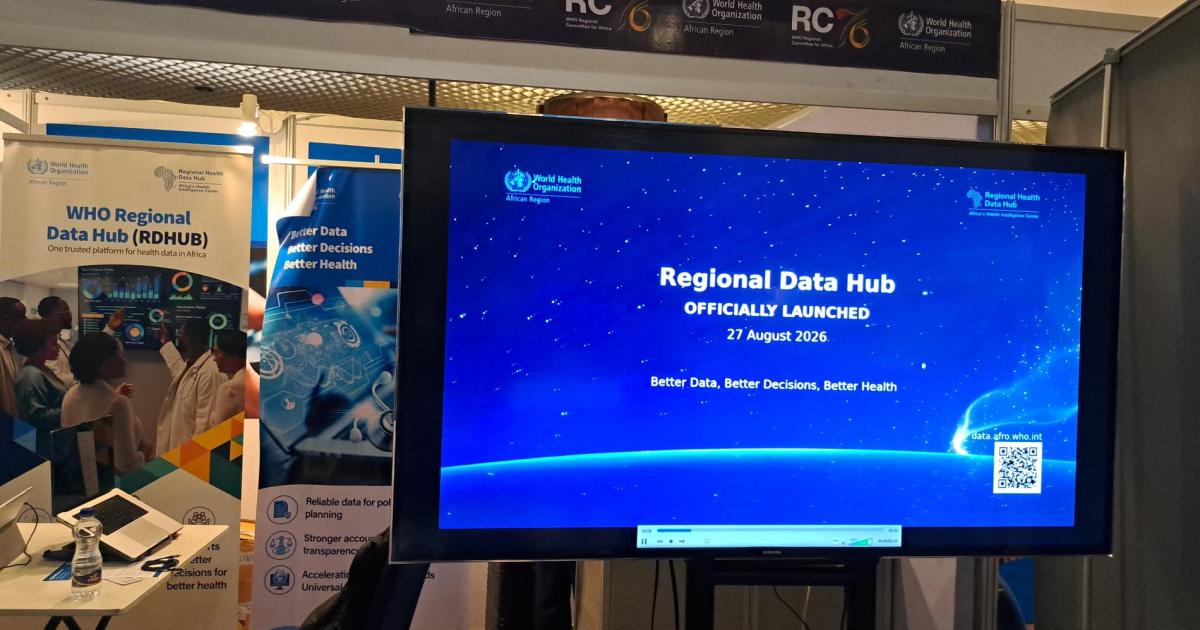
Addis Ababa—The World Health Organization (WHO) Regional Office for Africa has launched the Regional Health Data Hub (RDHUB) that brings together health information from across the region to facilitate access, analysis and use of trusted data by countries for decisions that improve health outcomes
Across the African Region, governments rely on timely and reliable health information to respond to disease outbreaks, improve maternal and child health, plan health services and allocate reagmented across multiple systems, making it challenging to obtain a complete and timely picture of population health
The RDHUB, launched during the Seventy-sixth session of the WHO Regional Committee for Africa (RC76) held in Addis Ababa, Ethiopia, from 25 to 27 August 2026, aims to address this challenge by connecting data from different health programmes and information systems and transforming fragmented information into actionable health intelligence. By bringing relevant information together, the platform allows users to explore trends, compare progress and identify emerging health priorities.
“We believe that no country in our region should have to make critical health decisions without access to the information it needs, and no health data generated with public reficult to interpret,” said Dr Abdouramane Diallo, Director of Programme Management, WHO African Region
The platform currently includes 53 datasets and 7965 indicators. All indicators have been formally registered, with their metadata defined and validated in collaboration with WHO clusters and countries. So far, 65% of datasets have been ingested, while data for 45% of indicators are available through the web portal. The target is to reach at least 80% dataset ingestion by the end of 2026
The Hub is designed to support all 47 Member States of the WHO African Region, as well as public health institutions, researchers, development partners and other users. It provides access to publicly available indicators and analytical products through the web portal, while more detailed country-level information and country-specific analytical products are made available through appropriate access arrangements.
One of the key strengths of the platform is its ability to bring together information from different zation planning, decision-makers can combine population data, vaccination coverage, disease surveillance and other health indicators to identify areas with low coverage or increased disease risk
The RDHUB was developed in response to a mandate from Member States and is intended to complement, rather than replace, national health information systems. Countries retain ownership of their data while benefiting from common standards that promote interoperability, data quality and secure information sharing
This approach is supported by a regional data governance framework that clarifies ownership, stewardship, access rights and responsibilities between Member States and WHO. It is intended to strengthen transparency, accountability and responsible data stewardship while building trust in the use and sharing of health information
“The Hub is being developed alongside a data governance framework that clarifies ownership, stewardship, access rights, and responsibilities between Member States and WHO,” said Dr Nancy Njeru Mucogo, Director, Healthcare Financing, Digital Health, Policy and Research Standards, Ministry of Health, Kenya
For countries, reliable evidence is essential not only for planning but also for ensuring that health decisions respond to the realities on the ground. Dr Ahmadou Lamin Samateh of The Gambia’s Ministry of Health highlighted the importance of strengthening the use of evidence in national decision-making
“Each country is trying to do its best in ensuring that information is correct, but they are not guided. So, evidence-based decision-making is very, very important and useful,” he said
The Hub also provides a foundation for stronger regional collaboration and learning. By making comparable health information more accessible, it can support countries to benchmark progress, identify common challenges and learn from approaches that have worked elsewhere in the Region
“There is a need for regional linkages to promote regional benchmarking, epidemic intelligence, and predictive analytics,” said Dr George Sinyangwe, Permanent Secretary, Donor Coordination, Ministry of Health, Zambia. “These virtues will strengthen our ability to identify trends, anticipate risks, and make evidence-based decisions more rapidly at national and regional levels.”
As the platform continues to evolve, additional datasets and indicators will be integrated, alongside enhanced analytical tools and more comprehensive Country Profiles tailored to national priorities. Artificial intelligence will also be further leveraged to support automated narrative generation, pattern identification and decision-support capabilities
The next phase will also focus on strengthening the integration of diverse datasets, enabling better triangulation of information and a more holistic understanding of health situations across the Region
The ambition is not simply to collect more data, but to ensure that existing health information is put to work. By turning fragmented data into actionable intelligence, the Regional Health Data Hub will support evidence-based decision-making, collaboration and accountability across the African Region — helping countries make better decisions that can lead to better health outcomes for millions of people.

1 Comment
Pingback: ‘You are not a bad mother’: transforming women’s mental health care during pregnancy and after childbirth in Armenia - EU NEIGHBOURS east - Healing families. Honouring love.