


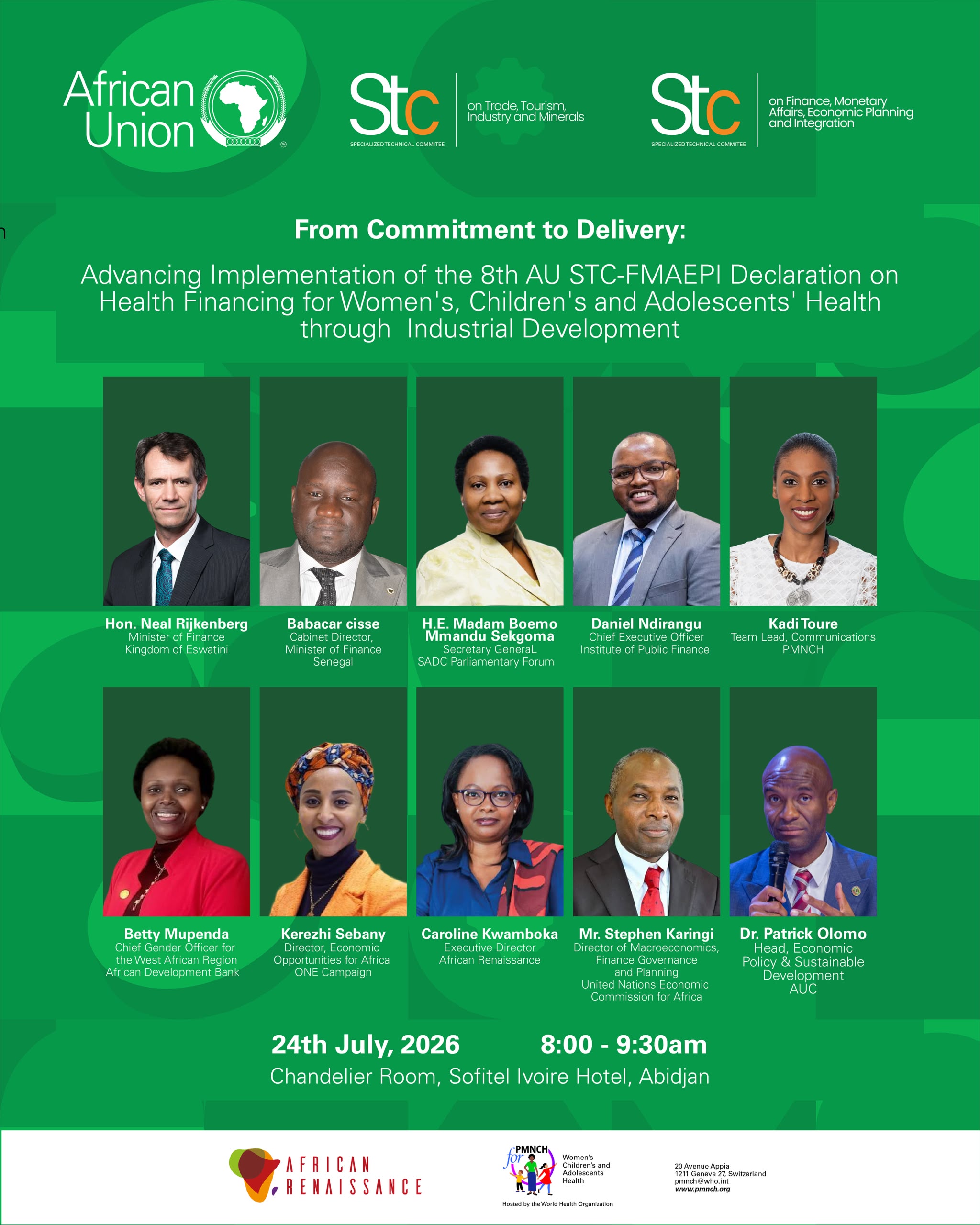
Abidjan, Côte d’Ivoire, 24 July 2026
Every year, 260,000 women die from causes related to pregnancy and childbirth. To put that number in perspective, it is the equivalent of filling a World Cup stadium to capacity and losing every person inside it, seven times over. Alongside them, nearly 5 million children die before their fifth birthday, and 1.9 million more are stillborn. These are not the headlines of a single crisis. They are the quiet, compounding toll of a health financing system that is losing ground, and on the margins of the African Union’s Specialized Technical Committee sessions in Abidjan, ministers, financiers and health leaders gathered to ask what it will actually take to reverse it.
The side event, convened by the African Union Commission, PMNCH and African Renaissance and moderated by Joseph Mireku Nti, Technical Expert at the AUC, returned to a Ministerial Declaration adopted by the STC in October 2025, one that called for stronger domestic health financing, innovative taxes and better public financial management. A year on, the room was candid about how much harder that commitment has become to keep. Official development assistance fell 23 percent in 2025, the steepest single-year cut on record, with a further decline projected this year. Funding for health specifically fell 21 percent, and Sub-Saharan Africa absorbed the deepest losses of any region, at 25 percent. In four out of every ten countries, governments now spend more servicing debt than they spend on health or education combined.
Joseph Mireku Nti, Technical Expert at the African Union Commission, highlighting the urgent need to strengthen domestic health financing amid declining global health assistance
PMNCH’s Kadi Toure laid out what those numbers mean in practice. A survey of PMNCH’s own membership found that nearly 90 percent of organizations had been directly affected by the funding cuts, and over 60 percent had already been forced to downsize programs, disproportionately in community health and sexual and reproductive health services, the very areas that reach women and adolescents first. Only three countries on the continent currently meet the Abuja target of allocating 15 percent of government spending to health. Progress that had cut maternal and child deaths by roughly 40 percent since the early 2000s has slowed sharply since 2016, and that slowdown predates the current financing shock.

Kadi Touré speaking on the impact of recent funding cuts, noting that nearly 90% of PMNCH member organizations reported being directly affected
Yet the conversation was not one of resignation.“We have no other choice than delivering,” African Union Commission’s Dr. Patrick Ndzana Olomo told the room, framing the work ahead as a climb every country and institution has to make together. He pointed to domestic resource mobilization as one of the clearest levers African governments can pull themselves, alongside innovative taxes on sectors like tobacco and continued reform of international tax rules.
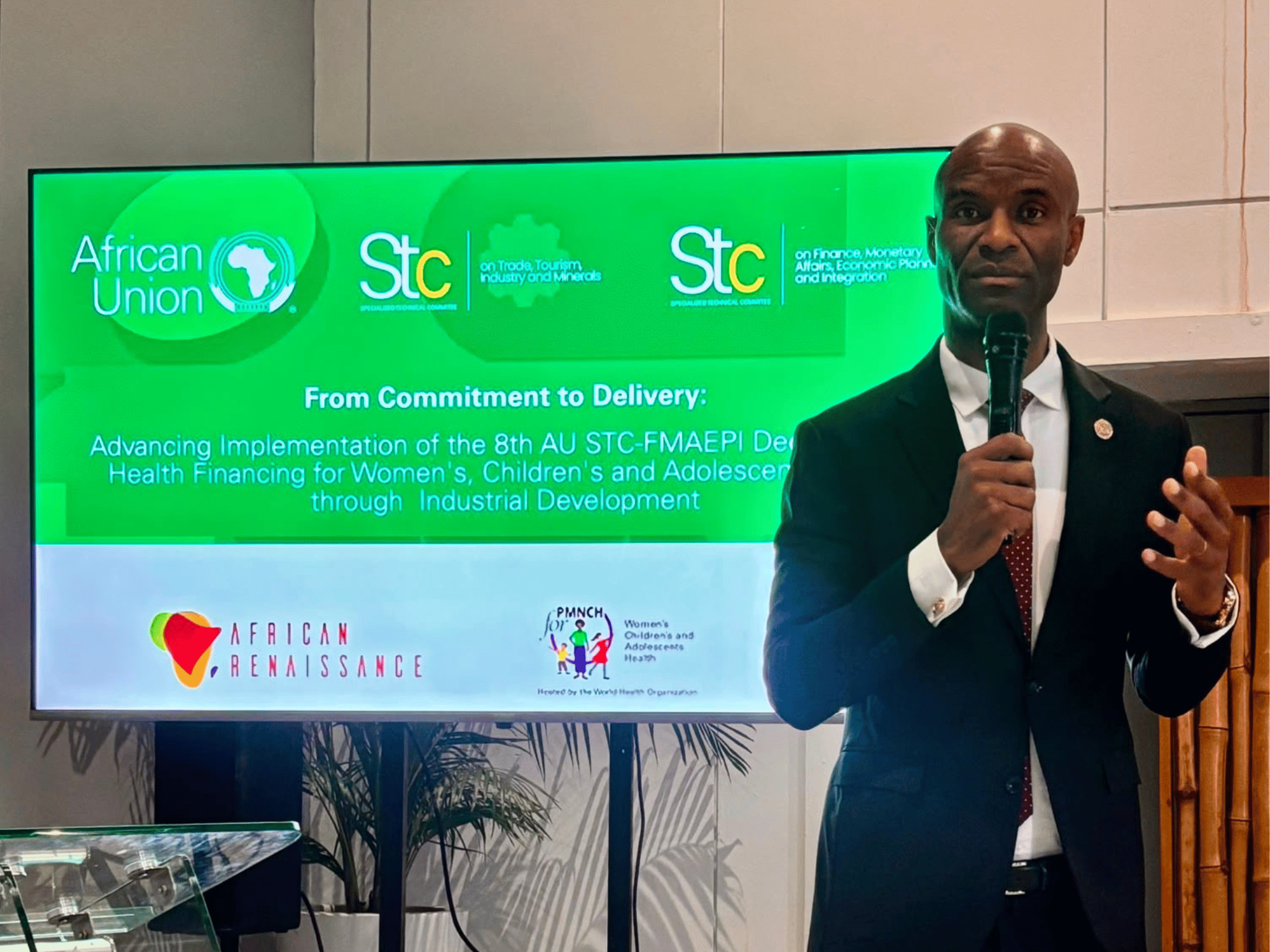
Dr. Patrick Ndzana Olomo emphasizing the importance of domestic re
Ministers brought concrete examples of what delivery can look like. Hon. Neal Rijkenberg, Eswatini’s Minister of Finance, described a debt swap arrangement with the African Development Bank, supported by the Gates Foundation, that channels every dollar of savings directly into health, with no room for it to be redirected elsewhere. He also argued for fewer, higher-quality clinics staffed and equipped to actually manage complications, rather than a wide network of facilities that cannot save a life when it matters most, alongside a new right-of-supply model that would let African manufacturers compete to produce the essential commodities the continent still imports. On the manufacturing question, the numbers are stark: Africa imports 80 percent of its health commodities, including 60 percent of the tranexamic acid used to control the postpartum hemorrhage that remains the leading cause of maternal death. Senegal offered the room a working example of what closing that gap looks like in practice: Mr. Babacar Cisse, Cabinet Director to the Minister of Finance, described the Institut Pasteur de Dakar’s Project MADIBA, a public-private partnership blending commercial and concessional finance from the IFC and the African Development Bank with support from the Mastercard Foundation to build domestic vaccine production, strengthen procurement and grow the skilled workforce the private sector needs to sustain it.
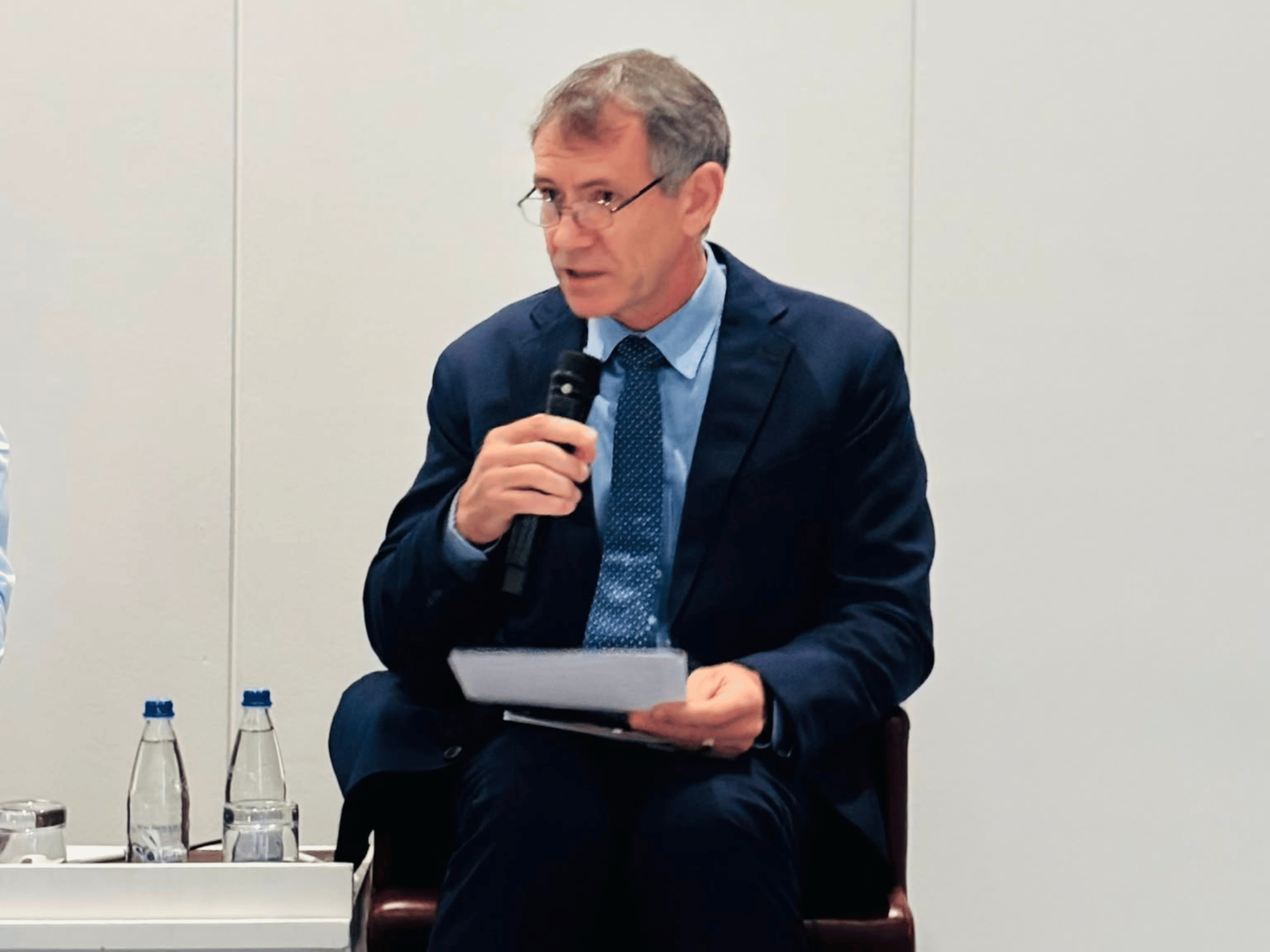
Hon. Neal Rijkenberg, Eswatini’s Minister of Finance, highlighting innovative financing and local manufacturing as key to strengthening Africa’s health systems
The panel that followed made clear that financing and manufacturing gains only reach people if the systems around them hold. H.E. Madam Boemo Mmandu Sekgoma, Secretary General of the SADC Parliamentary Forum, described a new African Financing Insight dashboard, tracking 27 indicators to hold both governments and legislatures accountable for turning financing commitments into approved, disbursed budgets, alongside a modern public financial management law meant to align executive and legislative branches around the same numbers. Daniel Ndirangu, Chief Executive Officer of the Institute of Public Finance, pushed the accountability question further down, into devolved units where debt service pressure is often felt hardest, arguing for greater financial autonomy for health facilities, a stronger essential benefit package, and a principle of subsidiarity that puts decision-making at the level closest to where care is actually delivered. Betty Mupenda, Chief Gender Officer for the West Africa Region at the African Development Bank, connected the Bank’s gender strategy directly to the agenda, describing gender-focused investment across West Africa’s health systems designed to reach the most vulnerable populations first. And Kerezhi Sebany, Director for Economic Opportunities for Africa at the ONE Campaign, closed the panel with a challenge to follow the money all the way to the frontline, arguing that civil society’s role is to keep that conversation honest, evidence-based and politically alive, not just at STC sessions but year-round.
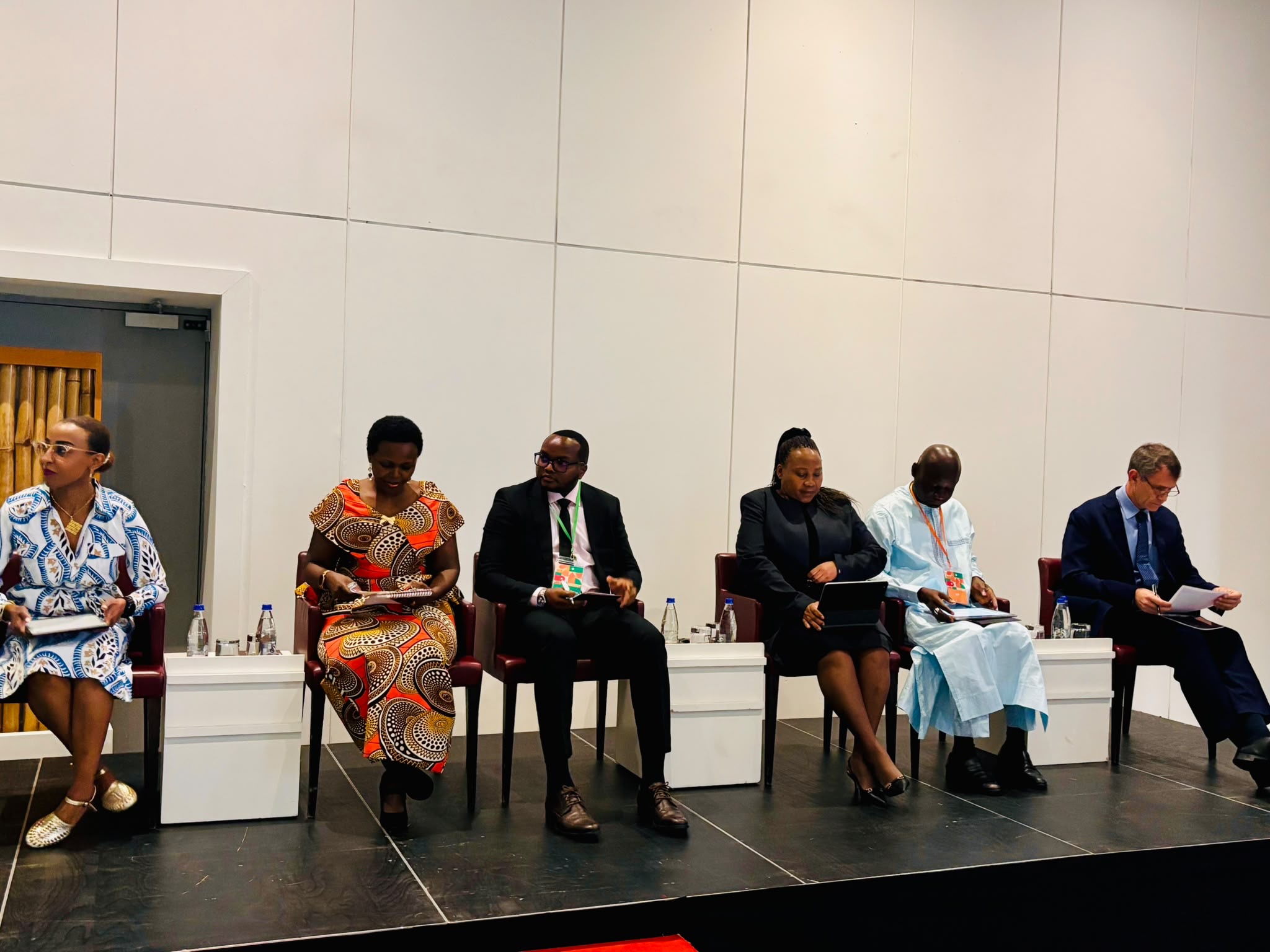
Panelists discussing how stronger financing, accountability and governance can help translate health commitments into better outcomes for women, children and adolescents
The session’s clearest deliverable was practical rather than declaratory. Caroline Kwamboka, Executive Director of African Renaissance, and Kafui Kumah demonstrated the African Financing Insight dashboard live, showing how its 27 indicators are meant to move health financing from a once-a-year pledge into something continuously tracked and visible. Participants also agreed to make this an annual fixture of the STC calendar, returning each year to account for progress on implementing the Declaration rather than letting it stand as a one-time commitment. And where last year’s Declaration set direction, this year’s session closed with a narrower, concrete commitment: PMNCH and its partners will continue advocating for debt relief, regional manufacturing and the use of locally produced essential drugs on the continent as the throughline of its health financing agenda into the next STC session. Closing remarks were delivered by Stephen Karingi, Director of Macroeconomics, Finance, Governance and Planning at the UN Economic Commission for Africa who reaffirmed the economic case for investing in women’s, children’s and adolescents’ health noting investment is required if Africa is to reap its demographic dividend.
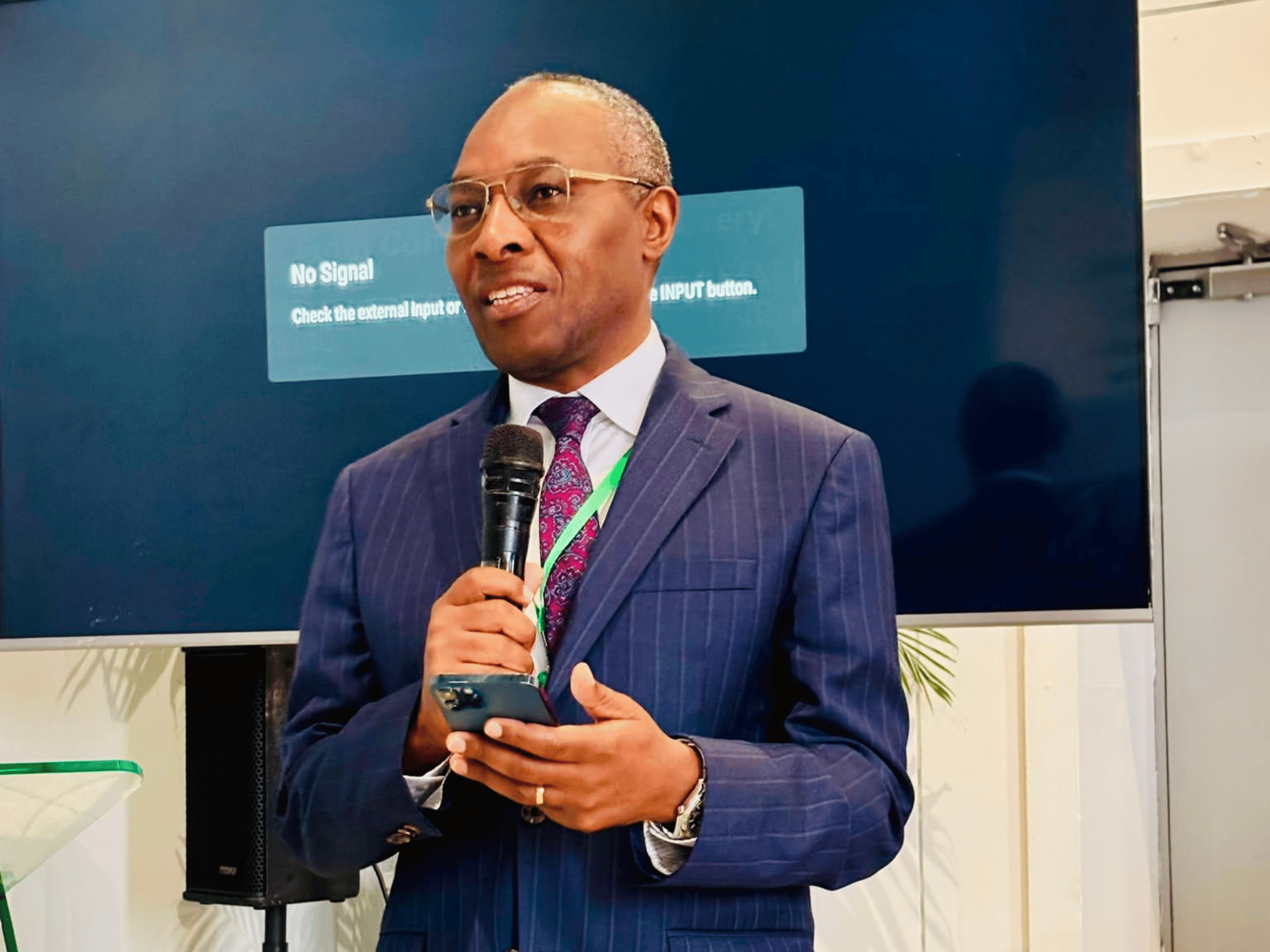
Stephen Karingi, Director of Macroeconomics, Finance, Governance and Planning at the UN Economic Commission for Africa, delivering the closing remarks and underscoring the economic value of investing in women’s, children’s and adolescents’ health
