


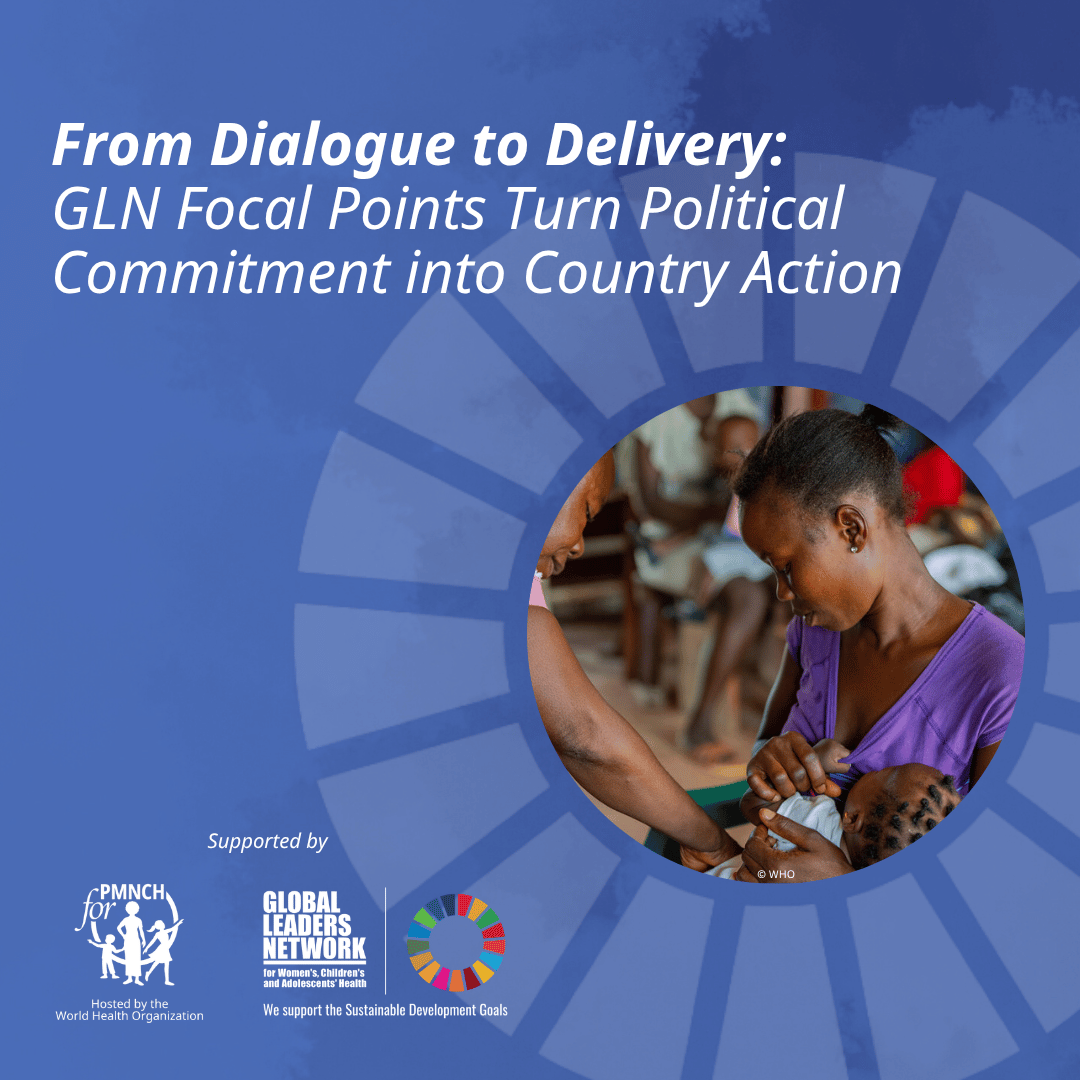
The Global Leaders Network for Women’s, Children’s and Adolescents’ Health (GLN) convened country focal points and partners from across the Network to take stock of how Heads of State commitments are being translated into concrete action: from expanding domestic financing and strengthening primary health care to advancing universal health coverage (UHC), accelerating maternal and newborn survival, and protecting sexual and reproductive health services. Together, they reaffirmed a shared vision for the next chapter of global health, one defined not by aid dependency but by health sovereignty, mutual accountability and South-South collaboration.
Opening the meeting, Dr Lwazi Manzi, Head of the GLN Secretariat, reflected on the Network’s evolution from two founding members- South Africa and Denmark- to twelve sitting Heads of State and Government spanning the Global South and the Global North, with further expansion expected in the coming year. That growth, she noted, had held firm through a turbulent geopolitical environment
“The fact that we have been able to grow the membership in a very, very volatile geopolitical environment, the fact that we’ve been able to retain membership even with regime changes and with changes of leadership, this really indicates to us that there’s clearly real value being derived in being part of the GLN.” — Dr Lwazi Manzi, Head of the GLN Secretariat
She highlighted the GLN’s role in supporting political leadership across its membership, including backing President Samia Suluhu Hassan of Tanzania in her role as African Union Champion for Maternal and Child Health, and investing in President William Ruto’s leadership of the World Health Summit Regional Meeting in Nairobi by sponsoring the maternal, newborn and child health track on the agenda.
That political leadership was reflected throughout the meeting. Across the Network, Heads of State are placing women’s, children’s and adolescents’ health (WCAH) at the centre of national development, mobilising whole-of-government action to deliver measurable results. Sierra Leone pointed to encouraging early outcomes from its Triple Zero campaign, where stronger accountability contributed to reductions in maternal and child mortality. In Malawi, that same commitment reached the district level through geo-mapping, enabling local authorities to identify gaps in maternal and newborn care and target resources where they were needed most. Kenya’s presidential launch of the Every Woman Every Newborn Everywhere (EWENE) Acceleration Plan was backed by significant domestic financing commitments and the recruitment of 5,000 nurses and midwives.
“This elevated maternal and newborn survival to the highest level of political leadership and demonstrated that reducing preventable maternal and newborn deaths is a national development priority, requiring a whole-of-government approach.” — Dr Julliet Omwoha, Head of the Newborn and Child Health Division, Ministry of Health, Kenya
The meeting also welcomed Spain as the Network’s newest member, extending the GLN’s growing political reach. Spain reaffirmed its commitment to advancing women’s, children’s and adolescents’ health, emphasising the importance of sustained political leadership and international solidarity at a time of shrinking development assistance and growing challenges to sexual and reproductive health and rights.
“Our Prime Minister has said time and again in different fora that Spain has a deep political engagement with this agenda.” — Mencía Manso de Zúñiga, Global Health Ambassador, Spain
Throughout the meeting, countries reflected on how they were responding to the steep decline in official development assistance. Members described a collective shift from managing funding gaps to reshaping how health systems are financed, governed and delivered. Ethiopia described expanding community-based health insurance to millions to reduce out-of-pocket spending. Liberia highlighted progress towards a national Health Equity Fund to widen equitable access to care. Somalia outlined reforms to align partner investments behind a single national plan, budget and reporting system, while Nigeria reflected on strengthening government ownership through integrated service delivery and pooled procurement. Senegal demonstrated how forward-looking planning can strengthen resilience, explaining that mapping financing needs and gaps early enabled the government to engage development partners and secure new commitments. While recognising that external financing remains essential, members were clear that the future lies in stronger domestic financing and greater self-reliance. As Dr Abera Bekele, Technical Advisor at Ethiopia’s Ministry of Health, noted, countries should “increase domestic financing, strengthen the health system and insurance mechanisms to ensure health sovereignty, and mobilise innovative financing mechanisms.”
The discussions also reinforced one of the Global Leaders Network’s greatest strengths: creating a platform where countries can learn directly from one another. Throughout the meeting, practical solutions developed in one country sparked interest among others facing similar challenges. The m-mama initiative emergency referral and transport system for pregnant women and newborns, which expanded into Malawi following its established success in Tanzania, offered a compelling model for reducing preventable maternal and newborn deaths, and a clear example of South-South learning in action. So too did Sierra Leone’s 300 Days of Activism and Liberia’s 365-Day Action Plan, launched within weeks of one another, demonstrated how different countries are pursuing complementary approaches to accelerate progress for WCAH.
As the meeting concluded, the discussions reinforced that the challenge is no longer one of identifying solutions, but of accelerating implementation. Three years on, GLN members are demonstrating, in budgets, in legislation and in services reaching women and children, that political leadership, sustainable financing and accountability can safeguard progress for women, children and adolescents even in the most demanding of circumstances.
