



For veterans seeking treatment for PTSD, depression, anxiety or substance use disorders, the question sounds simple: If a treatment exists, why can’t I get it through the VA?
The answer is more complicated than whether the Food and Drug Administration has approved it
Inside the Department of Veterans Affairs, a treatment can pass one scientific hurdle and still face others before it becomes routine care
VA says the process can involve research, clinical guidelines, medication reviews, patient-safety systems, ethics reviews and practical questions about whether the health system has the staff, space and equipment to deliver it
“VA moves new treatments into practice through a step-by-step process,” Dr. Ilse Wiechers, a VA <a href="https://lumeamara.online/?p=5993" title="Man who attacked nun on CCTV in Jerusalem acquitted on grounds of mental health“>mental health official, told Military Times. “Only after a treatment is shown to be safe and effective does VA roll it out more broadly.”
It starts with evidence, but evidence is only the beginning
A new treatment may start with research, move through increasingly larger clinical trials and, for drugs and certain medical devices, undergo FDA review. VA must then consider how the evidence applies to the veterans it serves and how a treatment fits into the health system
The 2023 VA/DoD Clinical Practice Guideline for PTSD uses the GRADE methodology to evaluate the quality and strength of evidence and weigh the benefits and harms of treatment options. The guideline also considers patient perspectives and feasibility when developing recommendations
The 2023 PTSD guideline applied GRADE more rigorously than the 2017 version, according to the guideline. That resulted in some recommendations being downgraded as the evidence was reevaluated
Recommendations can change as research develops, and veteran-specific evidence can matter, too
Wiechers said evidence involving veterans can be an important consideration when VA evaluates whether a treatment should become available, even when research in other populations is promising
For PTSD, however, the 2023 VA/DoD guideline says a lack of data on veterans or service members alone did not alter its recommendations. That helps explain why FDA approval and VA availability are not necessarily the same thing
Repetitive transcranial magnetic stimulation, or rTMS, offers a concrete example of how the VA adopts a new treatment
The FDA approved rTMS for depression in 2008. According to VA, the department then conducted a large study involving veterans, tested the treatment in a pilot program at 35 VA sites and expanded access after the pilot
VA says more than 60 of its facilities now offer rTMS, with some operating specialized clinics that combine it with other advanced depression treatments. Dr. Wiechers added that the success of the program’s original 35 clinics, as listed on the VA’s website, resulted in the program expanding to over 60 facilities
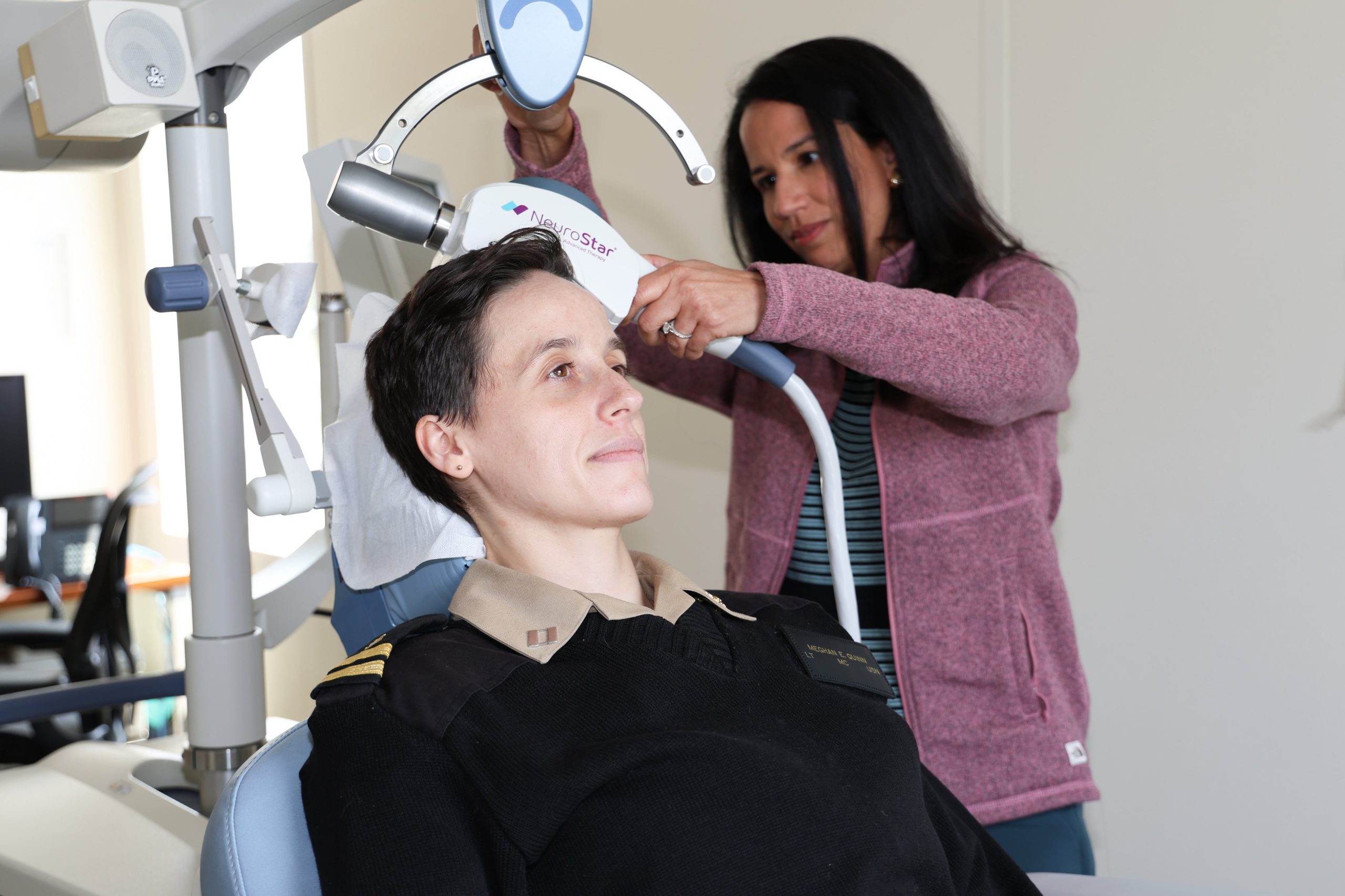
The sequence illustrates the difference between FDA approval and VA implementation. VA says it studied rTMS in its own patient population, tested its delivery across multiple facilities, and then expanded access
There is no single office that makes the decision
Dr. Wiechers described a team-based process in which draft policies are shared with offices responsible for delivering or overseeing a treatment. That allows potential risks, downsides and ethical concerns to be identified before policies are finalized
Among the offices involved, Dr. Wiechers identified the Office of Mental Health and its programs, including the National Center for PTSD; the Office of Suicide Prevention; Pharmacy Services; the National Center for Ethics in Health Care; Nursing Services; and Care Management & Social Work Services
The considerations extend beyond whether a treatment works
Wiechers said VA also considers whether it has enough trained clinicians, specialized equipment and space to deliver a treatment, as well as whether adding it could take re
For medications, another layer comes into play
VA’s National Formulary establishes the department’s national preferred list of medications. Some medications also have Criteria for Use documents that establish evidence-based conditions or restrictions for prescribing
VA says medication reviews can be prompted by new FDA approvals or research that could affect evidence-based prescribing, clinical practice or health outcomes for veterans
The formulary process includes VA physicians, Pharmacy Benefits Management officials and Veterans Integrated Service Network pharmacist executives. Formulary documents are reviewed, and feedback is solicited from health care teams
An FDA-approved medication, therefore, can be available in civilian medicine while having different prescribing conditions inside VA
That distinction can be particularly important for treatments that carry significant risks or require specialized monitoring
Emerging mental health treatments illustrate the difference between scientific promise and routine clinical care
The VA/DoD PTSD guideline, for example, recommends against benzodiazepines for PTSD, citing a lack of evidence of benefit and known harms, such as drug dependence and addiction
It also recommends against cannabis and cannabis-derived products for PTSD, citing a lack of well-designed randomized controlled trials and potentially serious side effects
Veterans are questioning why their legal cannabis license can’t be considered by the VA

“I have a medical cannabis license, and I have to pay for my medication out of pocket, but almost any other medication is covered by the VA,” explained George Canfield, a retired Army veteran
“Why can’t VA offer some kind of subsidy to offset the cost of this naturally derived treatment? I don’t expect a VA-run dispensary, but I would like it to be more affordable since it’s what helps me more than any other medication I’ve tried,” he said. “And I’ve tried them all!”
Ketamine presents a different example. The VA/DoD guideline retained a weak recommendation against ketamine for PTSD, citing limitations in the evidence and a lack of demonstrated effectiveness for the condition
Psychedelic-assisted therapies remain an area of active research, meaning promising findings do not by themselves establish a treatment as routine VA care
VA has recently expanded its research into psychedelic therapies and is recruiting veteran participants for clinical trials in select regions
For veterans, those distinctions can affect whether a treatment encountered outside VA is available or subject to different conditions within the federal health system
The process continues after a treatment enters clinical practice
VA says it monitors treatments through individual reports of adverse events or other problems, ongoing quality monitoring and formal research
If a patient experiences a bad reaction or other adverse outcome, local staff can report and investigate it. Dedicated safety programs can identify patterns that may warrant broader review or changes in guidance
VA also evaluates how treatments perform in actual clinical practice, particularly when a new treatment is introduced or when policies governing its use change
Once a treatment becomes standard care, researchers generally cannot create the same untreated comparison group used in many clinical trials

Dr. Wiechers said the most rigorous safety and effectiveness checks tend to occur early, while a treatment is still being rolled out
The process does not end there. VA and the Department of Defense periodically revisit clinical practice guidelines as evidence changes. The current 2023 VA/DoD PTSD guideline contains 34 evidence-based recommendations and is intended to assist, rather than replace, clinical judgment. The guideline is a tool for clinicians and does not define required care
For a veteran sitting across from a VA clinician, much of this process is invisible
The veteran sees a treatment that is available, restricted, unavailable or offered only through a clinical trial
Behind that decision may be years of research, clinical practice guidelines, formulary reviews, safety monitoring and assessments of whether VA can deliver the treatment
Dr. Wiechers said there are several reasons why a treatment may not be available to veterans
“VA only offers treatments that have solid research behind them showing they help,” she said. When a treatment is not available, she said, it may be because “the evidence isn’t strong enough yet, or it hasn’t been proven to work well specifically for Veterans.”
There is no single moment when someone decides a treatment “works.”
Instead, VA describes a sequence of decisions involving evidence, safety, effectiveness for veterans, clinical guidance, feasibility and rerch continue
The system is designed to answer a question bigger than whether a treatment works:
Is there enough evidence that it works for veterans, can VA deliver it safely and effectively, and should it become part of routine care?
