


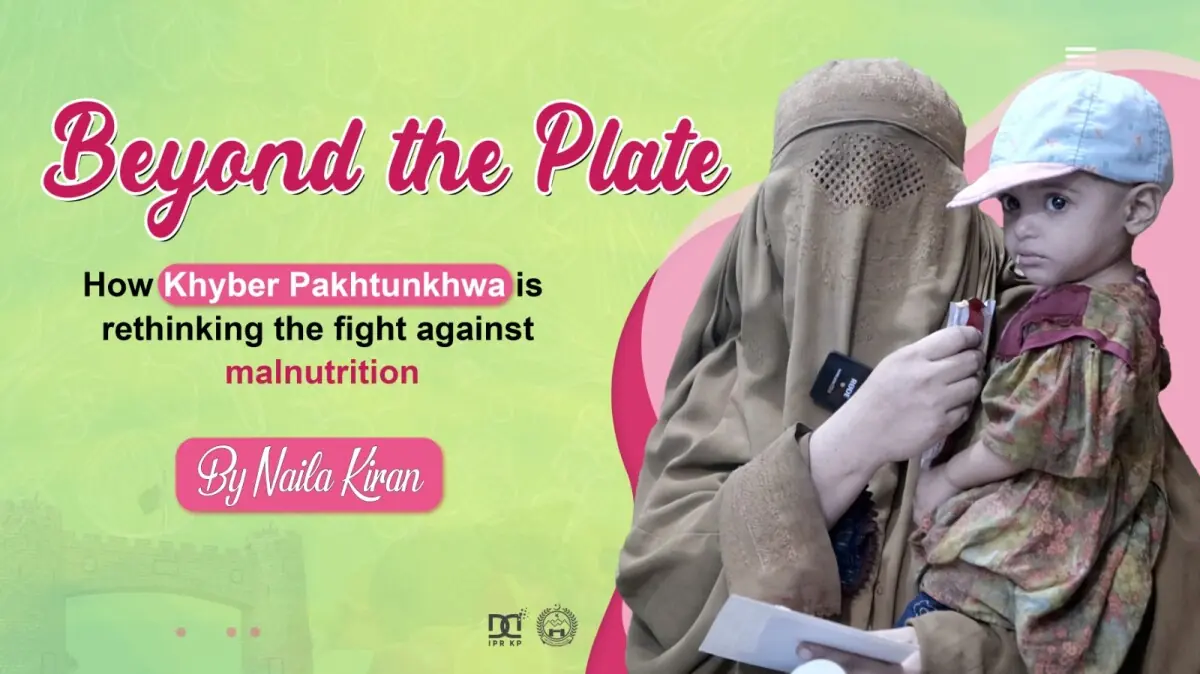
There is a familiar image of malnutrition: a hungry child, an empty plate, a family without enough food
It is an image that is not wrong. It is simply incomplete
A child can eat every day and still be malnourished. The food may lack essential nutrients. A mother may enter pregnancy anaemic or undernourished. A newborn may miss the earliest benefits of breastfeeding. A family may have food, but no clean water. A child may survive repeated infections and still fail to grow
Malnutrition is therefore not only about what is on the plate
It is about everything around it
That distinction is beginning to shape the way Khyber Pakhtunkhwa approaches one of Pakistan’s most persistent development challenges
The province continues to face a serious burden. According to the National Nutrition Survey 2018, 40 per cent of children under five in KP were stunted and 15 per cent were wasted. In the newly merged districts, the figures were significantly higher, at 48.3 per cent for stunting and 23.1 per cent for wasting
These numbers are sobering
But there is another story worth examining: the effort to change not only nutrition outcomes, but the way nutrition is built into government itself
KP has increasingly moved towards a model in which nutrition is considered in development planning, professional education, research, maternal and child health, social protection, food systems and emergency preparedness
That may be its most consequential innovation
When nutrition enters the planning room
One of the province’s most unusual interventions began not in a hospital but in the development-planning process
KP became the first province to develop nutrition markers for tracking nutrition-sensitive interventions in Annual Development Programme schemes
The principle behind the initiative is simple: development spending can influence nutrition even when a project has nothing explicitly to do with food
A water-supply scheme can reduce exposure to disease. An agricultural programme can affect dietary diversity. A road can determine how easily a pregnant woman reaches a health facility. Education can influence health and feeding practices. Social protection can determine whether a household can afford nutritious food
The child experiences these interventions as one environment
Government, however, often experiences them as separate departments
Nutrition markers attempt to narrow that gap
The idea is important because it shifts nutrition from being a specialised concern of health officials to becoming a consideration in the decisions that shape communities
It is a small change in administrative procedure with potentially large consequences
The battle against malnutrition begins before birth
The province’s health interventions continue to focus on the first 1,000 days—from conception until a child’s second birthday
This period receives enormous attention in nutrition science because growth and development during these early years can influence a child’s health and potential for years to come
KP’s Nutrition Cell at the Directorate General Health Services has been working across this window through maternal and child nutrition interventions, breastfeeding promotion, supplementation and treatment of acute malnutrition
The province has introduced multi-micronutrient supplementation for mothers and weekly iron and folic acid supplementation for adolescent girls
The latter is especially significant
The nutrition of a future mother is not determined on the day she becomes pregnant. It is shaped during the years before pregnancy
If nutrition policy begins only when a woman enters an antenatal clinic, it has already missed part of the story
Making breastfeeding a community responsibility
KP has also invested in making breastfeeding support more accessible
With UNICEF support, 27 breastfeeding rooms and day-care centres have been established in hospitals and educational institutions
The province is also implementing the Baby-Friendly Hospital Initiative and moving towards the Baby-Friendly Community Initiative, with the stated ambition of becoming the first province in Pakistan—and among the first in the region—to introduce the community-based model
The distinction matters
A mother can receive excellent advice inside a hospital and still struggle to follow it once she returns home
Breastfeeding is influenced by family practices, workplace conditions, social expectations and the availability of support. Taking the initiative into communities acknowledges that healthy behaviour cannot be created by medical advice alone
It has to be supported by the environment in which people live
Building nutrition into the health workforce
A policy can only be as strong as the people who deliver it
KP has therefore worked with academia and UNICEF to harmonise nutrition curricula across BS/MS and allied health sciences programmes
The effort seeks to ensure that nutrition is not treated as a narrow specialisation, but becomes part of the professional knowledge of doctors, nurses and allied health workers
The province has also established a Centre of Excellence for Nutrition and Child Development at Khyber Medical University, creating a platform for research and evidence generation
This could prove particularly valuable
Pakistan does not need only more nutrition campaigns. It needs more answers to practical questions: Which interventions work best in which communities? What reaches mothers in remote areas? Which approaches are affordable at scale? What survives a flood, an economic shock or a disruption in health services?
Local research can turn those questions into evidence
From programmes to learning
That principle is visible in KP’s operational research on multi-micronutrient supplementation in Swabi, undertaken with support from Nutrition International
The importance of such research goes beyond one district or one supplement
Public policy improves when governments are willing to test their assumptions
A programme that looks effective on paper may encounter very different realities in the field. Mothers may face transport problems. Health workers may be overstretched. Supplies may arrive late. Families may have concerns about a particular intervention
Research allows policymakers to see those gaps—and, ideally, fix them
The food people already eat matters
Not every nutrition problem can be solved by asking families to change their diets
For millions of households, affordability is part of the equation
That makes food fortification an important part of KP’s strategy
The province’s programmes include Universal Salt Iodisation, wheat flour fortification and oil fortification, targeting micronutrient deficiencies through foods already consumed by large sections of the population
It is a different kind of intervention: instead of asking every household to acquire a new product or adopt an entirely new habit, essential nutrients can be delivered through commonly consumed foods
The principle is particularly relevant in a province where poverty and food insecurity can limit the choices available to families
Nutrition beyond the health department
KP’s approach has also moved into schools and social protection
The province is pursuing school-age deworming for children aged 5 to 14, while nutrition has been incorporated into the Integrated Health Project
Through SUN-KP, the Scaling Up Nutrition platform, and the province’s Multi-Sectoral Integrated Nutrition Strategy, nutrition is being connected with sectors beyond health
The logic is straightforward
A health department can treat a malnourished child. It cannot, by itself, determine the price of food
A doctor can recommend handwashing. A doctor cannot build a water system
An agriculture department can increase food production. It cannot guarantee that a poor family can afford a diverse diet
Nutrition sits at the intersection of all three
That is why the province’s KP-SPRING—Khyber Pakhtunkhwa Stunting Reduction Integrated Nutrition Gain—and other nutrition-sensitive initiatives are significant not simply as programmes, but as attempts to make different parts of government work towards a common outcome
Protecting children when crisis strikes
For KP, emergency preparedness cannot be separated from nutrition policy
The province has developed a Nutrition Emergency Response Plan and maintains an Emergency Nutrition Cluster Coordination mechanism
It has been activated during major emergencies, including COVID-19 and the floods of 2022 and 2024
This matters because disasters rarely affect all families equally
A household already struggling with food insecurity can be pushed into severe nutritional vulnerability by a flood, displacement, disease outbreak or sudden loss of income
For children, deterioration can happen quickly
A nutrition response therefore cannot begin after a crisis has already disrupted food supplies and health services. It has to be designed before the emergency arrives
Where social protection meets nutrition
There is perhaps no clearer example of the connection between household economics and nutrition than the BISP Nashonuma Programme
The programme links conditional cash transfers with maternal and child nutrition, targeting vulnerable BISP-registered pregnant and lactating women and children under two
Its significance lies in the connection it makes between two issues that governments have often treated separately: poverty alle
Cash support can help a family meet immediate needs. When that support is linked to maternal and child health and nutrition, it can also become an investment in the next generation
The idea deserves attention well beyond nutrition policy
The real test is reach
There is, however, a point at which innovation must give way to implementation
KP has developed a substantial architecture around nutrition. But a programme established in Peshawar is only as successful as its ability to reach a mother in a remote district
The province’s burden also remains high, particularly in the newly merged districts
This is where the next chapter becomes more difficult
Can these interventions be sustained?
Can district-level health systems deliver them consistently?
Can nutrition remain a priority when fiscal pressures increase?
Can data tell policymakers not only what has been achieved, but who is still being left behind?
And can successful experiments move from pilots and projects into routine government systems?
These questions are more important than another announcement
A different way of thinking
Khyber Pakhtunkhwa is not the first place to discover that malnutrition is complex
What is noteworthy is the range of mechanisms it is putting together to address that complexity
Nutrition markers in development planning
Nutrition in professional curricula
A research centre focused on nutrition and child development
Breastfeeding support in hospitals and communities
Maternal and adolescent supplementation
Community management of acute malnutrition
Food fortification
School-age deworming
Social protection linked to nutrition
Emergency nutrition planning
And a multi-sectoral structure that attempts to bring different departments into the same conversation
Taken individually, none of these measures can transform a province’s nutritional profile
Together, they suggest a more ambitious proposition: that nutrition should not be treated as a programme sitting inside government, but as an outcome that government as a whole must help produce
That may be the lesson KP can offer the rest of Pakistan
The province should not claim victory. The numbers do not permit it, and the unfinished work is too large
But there is value in demonstrating that a different approach is possible
The ultimate measure will not be the number of strategies written, centres opened or initiatives announced
It will be whether a girl enters adulthood better nourished
Whether a mother enters pregnancy healthier
Whether a newborn receives the right start
Whether a child grows without the invisible burden of chronic undernutrition
And whether the institutions around that child are strong enough to protect those gains when the next crisis comes
Malnutrition may begin before a child can speak
The response, therefore, has to begin before the problem becomes visible
That is the real promise—and the real test—of Khyber Pakhtunkhwa’s nutrition experiment
This content is produced in paid partnership with the Khyber Pakhtunkhwa (KP) government – a partner of DawnMedia’s Act for Nutrition initiative
