


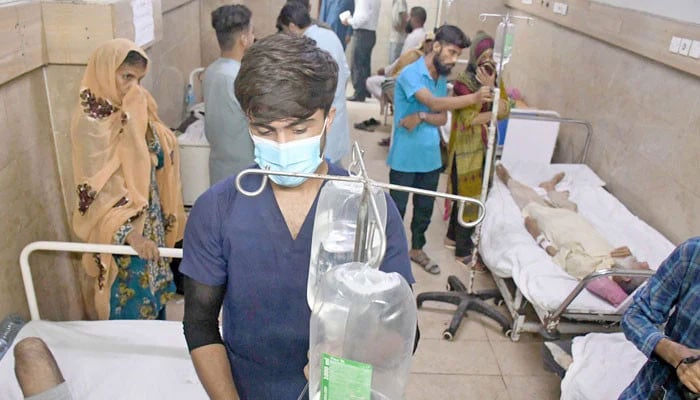
When Pakistan’s interior minister recently declared that, whether the country admitted it or not, “this system has collapsed”, he was talking primarily about governance. But anyone looking for the most painful evidence of that collapse need not examine parliament, the civil service or the police. He could walk into an ordinary health facility
There, the consequences of institutional failure are measured not in files gathering dust but in infected blood, stunted children and lives cut short. Pakistan spends remarkably little on public health. The Pakistan Economic Survey 2025-26 puts public health expenditure at just 0.8 per cent of GDP. Life expectancy is 67.8 years. In a country of more than 250 million people, this indicates what the state values. The most shocking evidence comes from HIV. Pakistan is moving against the global trend. While new HIV infections worldwide have fallen substantially since 2010, Pakistan has one of the fastest-growing epidemics in the WHO Eastern Mediterranean region.
Around 350,000 Pakistanis are estimated to be living with HIV and roughly four out of five may not know their status. Even more disturbing is how some children are becoming infected. In 2019, Ratodero in Sindh became internationally notorious after hundreds of children tested positive for HIV. Unsafe injections, poor infection control and an inadequately regulated medical sector were implicated. Seven years later, the country is still confronting essentially the same scandal. During the first quarter of 2026 alone, Sindh recorded 894 new HIV cases, including 329 children, according to figures cited by the Pakistan Medical Association.
More recently, another outbreak linked to a government hospital in Karachi has added to the alarm. The tragedy is difficult to comprehend precisely because it is so avoidable. Imagine parents taking a feverish child to hospital. They assume that the injection being administered will make their child better. Instead, because of a reused syringe, contaminated equipment or some other failure of infection control, the treatment itself becomes the source of a lifelong infection. There are few more devastating inversions of the purpose of medicine. HIV is only one warning light flashing on Pakistan’s public-health dashboard. Hepatitis C is another.
WHO research puts national HCV prevalence at about 7.5 per cent, with provincial surveys showing 8.9 per cent in Punjab and 6.1 per cent in Sindh. Pakistan now carries the world’s highest HCV burden. The connection between these epidemics matters. Unsafe injections, poorly screened blood, inadequate sterilisation and weak regulation can transmit blood-borne infections. Prime Minister Shehbaz Sharif’s decision in July to order action against substandard syringes and negligent hospitals is therefore welcome. But Pakistan has had regulations, programmes, committees and crackdowns before. Its difficulty lies less in discovering what ought to be done than in ensuring that somebody actually does it.
This is particularly visible in Sindh. I have spent much of my life in Karachi and what strikes me is the extraordinary coexistence of medical excellence and public-health failure. Karachi has superb doctors, sophisticated private hospitals and specialists capable of providing treatment comparable with that available internationally. Yet travel beyond the protected islands occupied by the affluent and another Sindh appears. In poorer districts, the citizen encounters overcrowded facilities, shortages, unregulated practitioners, unsafe water and sanitation problems that turn ordinary illness into a recurring hazard. This is why health inequality cannot be understood merely by counting hospitals.
Sindh’s crisis of child nutrition illustrates the point. World Bank figures have put stunting in the province at almost half of children under five. Flood-affected districts combine poverty, food insecurity, poor sanitation and inadequate maternal and child healthcare. Nationally, about two in five children are stunted, a condition that damages not merely height but cognitive development, educational achievement and eventual productivity.
Stunting is sometimes discussed as though poor families simply need more food. The reality is considerably more complicated. A pregnant woman who is anaemic or undernourished may give birth to an underweight baby. A child repeatedly exposed to diarrhoea because drinking water is contaminated cannot absorb nutrients efficiently. Poor sanitation, inadequate breastfeeding, deficient diets, frequent infections, poverty and limited access to primary healthcare then reinforce one another. A malnourished child is therefore not simply evidence of an empty kitchen. The child may also be evidence of a broken water system, an absent health worker, an undereducated mother and a dysfunctional local government.
This is why the Sindh government’s move towards integrating health, nutrition, sanitation and social protection is sensible. The World Bank’s programmes in the province increasingly recognise that these problems cannot be solved in administrative silos. Its current Sindh Integrated Health and Population Project explicitly combines health, nutrition, population services and system strengthening. The principle should be expanded. Pakistan needs to reorganise maternal and child health around the first 1,000 days from conception to a child’s second birthday. Every <a href="https://lumeamara.online/?p=5218" title="Are antidepressants safe during pregnancy?”>pregnancy should trigger a chain of interventions: antenatal checks, nutrition support, iron and other appropriate micronutrients, safe delivery, breastfeeding counselling, vaccination, growth monitoring and rapid treatment when illness occurs.
The infrastructure partly exists already. Pakistan’s Lady Health Worker programme is one of those institutions whose potential is greater than its present performance. Properly trained, adequately paid and effectively supervised LHWs can connect households with a health system that otherwise appears distant. Recent Unicef-supported work continues to demonstrate their importance in newborn care
Breastfeeding provides another example of the strange Pakistani habit of knowing the solution while failing to organise it. Only around 48 per cent of Pakistani infants are exclusively breastfed during their first six months. Unicef rightly describes breastfeeding as a public-health intervention rather than merely a private maternal choice. Mothers require counselling, supportive workplaces and health facilities that do not casually encourage substitutes. In Sindh this becomes particularly important during floods. Formula milk requires clean water, hygienic preparation and dependable supplies. Flood camps may offer none of them. Breastfeeding is consequently a remarkably resilient form of infant nutrition in a climate-vulnerable province. This connection between health and climate will become harder to ignore. The 2022 floods demonstrated how quickly stagnant water, destroyed sanitation systems, displacement and interrupted medical services can create secondary health emergencies. Sindh will experience more such shocks.
Karachi itself offers the national paradox in miniature. It contains some of Pakistan’s finest medical institutions while millions of its residents struggle with water, sewage, pollution and inadequate primary care. The World Bank approved another $240 million in 2024 for improved water, sanitation and hygiene services in the city, explicitly connecting safe water with public health and the battle against stunting. Yet loans cannot substitute indefinitely for government. Nor can international donors. Pakistan has benefited enormously from the Global Fund, Unicef, WHO, the World Bank and other development partners. But a country of Pakistan’s size cannot outsource responsibility for protecting its population from HIV, hepatitis, malnutrition and preventable childhood deaths.
The uncomfortable question is not whether Pakistan knows what to do. It does. It needs safe syringes and screened blood. It needs functioning primary healthcare. It needs properly funded Lady Health Workers. It needs clean drinking water, sewerage and nutrition programmes. It needs vaccination, family planning and breastfeeding support. Above all, it needs data that cannot be hidden, regulators who actually regulate and officials who face consequences when systems fail. There are encouraging signs. The Benazir Nashonuma Programme, whose extension was announced in July, is expected eventually to reach 8m vulnerable women and children through an integrated nutrition and health approach.
The World Bank’s new ten-year framework for Pakistan also puts stunting, health, nutrition, sanitation and resilience near the centre of development policy. But Pakistan has never suffered from a shortage of projects. It suffers from a shortage of continuity, accountability and implementation
The writer is dean of the faculty of liberal arts at a private university in Karachi. He tweets/posts @NaazirMahmood and can be reached at: [email protected]
