

Close Menu
Healing families. Honouring love.
    Subscribe
    What's Hot

    Nicklaus Children’s Hospital Performs One of the First Transcatheter Fontan Completions in the Country on a Two-Year-Old Child

    September 10, 2026

    How Social Media and AI Chatbots Are Reshaping Youth Mental Health, and What Congress Can Do About It

    September 10, 2026

    How a midwife in Chad is helping Sudanese women rebuild their lives | The IRC

    September 10, 2026
    Facebook X (Twitter) Instagram
    Facebook X (Twitter) Instagram TikTok
    Healing families. Honouring love.
    SUBSCRIBE
    • Home
    • Health News
    • Mental Health
    • Family Wellness
    • Parenting
    • Pregnancy
    Healing families. Honouring love.
    Home»Pregnancy»“We don’t have to endure everything”: Motherhood, vulnerability, and the racism that runs through childbirth
    Pregnancy

    “We don’t have to endure everything”: Motherhood, vulnerability, and the racism that runs through childbirth

    adminBy adminSeptember 4, 2026No Comments5 Mins Read
    “We don't have to endure everything”: Motherhood, vulnerability, and the racism that runs through childbirth
    Share
    Facebook Twitter Reddit Telegram Pinterest Email

    BRASILIA, Brazil – “Black women are the majority of women living in precarious conditions in our country,” said Isabela Cristina Correia de Lima Lima, a Brazilian singer-songwriter, known professionally as IZA. “And of course that extends to pregnancy, to the moment of birth.”

    Across the Americas, women of African descent face higher maternal death rates than women from any other racial background, according to a recent report by UNFPA, the United Nations Population Fund, which is the UN’s sexual and reproductive health agency. Racist attitudes and practices persist in healthcare, extending from verbal and physical abuse to the denial of quality care, coercive or unconsented medical procedures, refusal of pain medication and violations of privacy.

    In Brazil, from contraception to pregnancy and childbirth, inequalities run through reproductive healthcare. In 2024, the maternal mortality ratio among Black women in Brazil was 55 per cent higher than among white women. In the same year, almost 85 per cent of pregnant white women had at least seven prenatal care visits, compared with 77 per cent of Black women

    A woman in a white t--shirt and green and yellow corset top holds a microphone while standing on stage and raising her left arm. Behind her dancers visible from the back wear bright blue outfits
    Isabela Cristina Correia de Lima Lima, a Brazilian singer-songwriter, known professionally as IZA, is a maternal health and anti-racism advocate with UNFPA’s Across Borders campaign. ©duoimage 

    IZA has become an advocate for access to comprehensive maternity care for Black women in Brazil, working with UNFPA’s Across Borders campaign. “I had all the support, all the patience, all the care that a pregnant woman deserves,” IZA, 35, told UNFPA, describing her own pregnancy. “That’s not what happens for most women living in a different situation. I think that in that moment, when I was the most vulnerable in my life, that made me pay even closer attention to this issue.”

    Care, time and choices for all

    Two women seated outside smile into the camera; behind them is a UNFPA-branded poster about reducing adolescent pregnancies
    Honduran Garifuna women Florencia Gonzales and Eva Esther Bernárdez represent different generations working to prevent adolescent pregnancy, as part of UNFPA’s ‘Leave No One Behind’ project in their territory. © UNFPA Honduras

    Brazil is one of just three countries in Latin America and the Caribbean – along with Colombia and Suriname – that collect and report maternal health data disaggregated by ethnicity or race. With UNFPA’s support, 18 countries across Latin America and the Caribbean now include ethnic and racial identifiers in their national censuses – a critical step in building inclusive, equity-driven sexual and reproductive health policies and systems.

    Across Latin America and the Caribbean, UNFPA data show that Afrodescendent girls are 50 per cent more likely to become pregnant in their teens than their non-Afrodescendent peers. Some 20 women die every day from causes related to pregnancy or childbirth, and for Indigenous and Afrodescendent women, the risk is up to three times higher – statistics that indicate historical patterns of race-based reproductive discrimination continue today. 

    “It is important that we have control and autonomy, specifically over the decisions that have to do with our health and our bodies,” Edna Liliana Valencia, a Colombian journalist, writer and activist, told UNFPA. “The people responsible for public policies at a global level must take concrete actions to protect the lives of Afrodescendent girls and women.”

    IZA shares these views. “We need to talk about policies that support this population, that give them access to quality treatment, so they can choose, […] so they have access to psychological care, that they have support during breastfeeding, which is a very delicate moment. And that shouldn’t be limited to people with financial means, it should be the reality for all of us.”

    Comprehensive care is critical for well-being 

    A pregnant woman lies on a maternity bed smiling, while a health worker in blue scrubs and white face mask attends to her
    Leonor Pinheiro is a midwife at Casa Angela, a UNFPA_supported maternity ward in São Paulo, Brazil. © UNFPA Brazil

    IZA also spoke about the mental health concerns that motherhood can bring. “There’s this mistaken idea that we’re strong, that we’re warriors, that we can endure anything. We don’t have to endure everything, we don’t have to be strong all the time, and society shouldn’t demand that of us.”

    This belief was shaped by the birth of her daughter, Nala. “After I became a mother, it became very clear to me how much strength there is in vulnerability,” she said

    “I think it’s important for Nala to see how much that’s part of who we become. So I’ve allowed myself to be more vulnerable, I take better care of myself, because the more I care for myself, the better mother I am.”

    Equality and access are key 
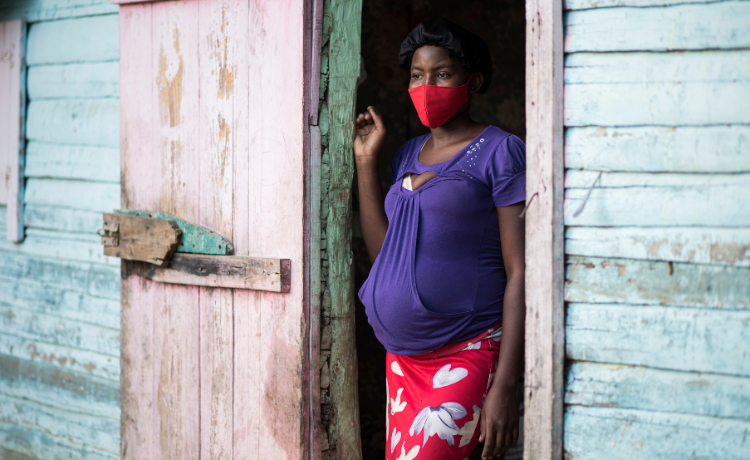
    A pregnant woman in a dark purple top and red and white patterned skirt wears a red facemask while leaning against the pale pink doorframe of a turquoise-coloured wooden building
    A pregnant woman stands at the door of her home in the Dominican Republic. ©2020/Bayoan Freites

    Through initiatives like Leave No One Behind in Central America, UNFPA is partnering with governments and communities to expand access to family planning, provide culturally affirming sexuality education, and strengthen adolescent-responsive services for Afrodescendent and Indigenous girls

    “As a Black woman and a mother, I know that motherhood can bring immense joy, but also expose deep inequalities,” said Florbela Fernandes, UNFPA Representative in Brazil. “Dignified, respectful and racism-free care must be a right for every woman, never a privilege.” 

    To dismantle the systemic barriers that marginalized women face, UNFPA supports inclusive health and policy initiatives across Latin America and the Caribbean. For instance, in Colombia, the Partera Vital equips birth attendants with mobile technology to more easily register births among Afrodescendent communities – where home births are more prevalent– and trains them to identify pregnancy risks. And in the Dominican Republic, mobile medical teams travel distances to reach pregnant women in  Afrodescendent and other marginalized communities.

    dont endure everything have Motherhood
    Share. Facebook Twitter Pinterest LinkedIn Telegram Reddit Email
    Previous ArticleInvestigation into newborn death at Fort Collins birth center leads to criminal charges for owner, midwife
    Next Article Perez Hilton faces huge blow amid his mental health crisis: ‘It’s deeply traumatic’
    admin
    • Website

    Related Posts

    How a midwife in Chad is helping Sudanese women rebuild their lives | The IRC

    September 10, 2026

    Ectopic Pregnancy Deaths Have Nearly Doubled. It’s Worse in States With Abortion Bans.

    September 9, 2026

    Pregnancy, poverty and the weight of hunger for child brides in Yemen

    September 9, 2026

    Mental health groups have ‘failed to acknowledge’ risk of violence, says Mind chief

    September 8, 2026

    ‘You are not a bad mother’: transforming women’s mental health care during pregnancy and after childbirth in Armenia – EU NEIGHBOURS east

    September 8, 2026

    AD1229: Few Malians support women’s autonomy in decisions about marriage and childbearing

    September 8, 2026
    Add A Comment
    Leave A Reply Cancel Reply

    Stay In Touch
    • Facebook
    • Twitter
    • Pinterest
    • Instagram
    • YouTube
    • Vimeo
    Don't Miss

    Nicklaus Children’s Hospital Performs One of the First Transcatheter Fontan Completions in the Country on a Two-Year-Old Child

    By adminSeptember 10, 2026

    Novel Transcatheter-Based Approach Allowed a Child with Congenital Heart Disease Avoid Additional Open-Heart Surgery

    How Social Media and AI Chatbots Are Reshaping Youth Mental Health, and What Congress Can Do About It

    September 10, 2026

    How a midwife in Chad is helping Sudanese women rebuild their lives | The IRC

    September 10, 2026

    Dr Vanessa Kerry appointed to new role as WHO Director-General’s Special Envoy for Health Resilience

    September 10, 2026
    Healing families. Honouring love.

    Lumeamara (www.lumeamara.online) is South Africa's first family grief and wellness platform, supporting parents through pregnancy loss, infertility, and family change — with trusted health news alongside.

    Our Picks

    Dr Vanessa Kerry appointed to new role as WHO Director-General’s Special Envoy for Health Resilience

    September 10, 2026

    Whatever happened to the measles outbreak that shocked a country this year?

    September 9, 2026

    World Mental Health Day webinar

    September 9, 2026
    Recent Posts
    • Nicklaus Children’s Hospital Performs One of the First Transcatheter Fontan Completions in the Country on a Two-Year-Old Child
    • How Social Media and AI Chatbots Are Reshaping Youth Mental Health, and What Congress Can Do About It
    • How a midwife in Chad is helping Sudanese women rebuild their lives | The IRC
    • Dr Vanessa Kerry appointed to new role as WHO Director-General’s Special Envoy for Health Resilience
    • Whatever happened to the measles outbreak that shocked a country this year?
    Facebook X (Twitter) Instagram TikTok
    • About Us
    • Contact Us
    • Terms & Conditions
    • Privacy Policy
    • Disclaimer

    © 2026 lumeamara.online. All rights reserved. Designed by DD.

    Type above and press Enter to search. Press Esc to cancel.