



Sexual and reproductive rights encompass the rights enabling every person to access sexual and reproductive health services, receive appropriate sexuality education, maintain bodily integrity, choose their sexual partners, exercise autonomy regarding marriage on the basis of equality between spouses, lead a safe and satisfying sexual life, and freely choose their sexuality, sexual orientation, and gender identity (Starrs et al., 2018).
This integrated definition highlights the importance of sexual and reproductive health and rights (SRHR) for economic and social development, as well as their direct link to gender equality. In many countries, including Mali, access to sexual and reproductive health services and the right to make decisions about one’s own body – free from stigma, discrimination, and any form of coercion – are not guaranteed in practice, even though the law ensures these rights equally for men and women (United Nations Population Fund, 2025).
In 2023, the utilisation rate for modern contraceptive methods in Mali stood at only 22%, with marked regional disparities ((Institut National de la Statistique, 2024). That same year, 49% of women received no assistance during childbirth and 14% had no prenatal check-ups, with significant gaps between rural and urban areas.
These shortcomings in access to reproductive health services are also reflected in <a href="https://lumeamara.online/?p=6397" title="Church donates $1.2 million to UNICEF for maternal and newborn health in Pakistan”>maternal health indicators. In 2018, the maternal mortality rate was estimated at 325 deaths per 100,000 live births – a level far above the target set by the United Nations (UNICEF, 2024)
Access to quality sexual and reproductive health services remains limited due to several factors, notably inadequate social and health infrastructure, low health-service coverage (76% within a 15 km radius), and the weight of sociocultural norms that can affect the health of vulnerable groups (Direction Nationale de la Santé, 2017; Ministère de la Santé et des Affaires Sociales, 2019)
To improve access to and the quality of health services – including those related to sexual and reproductive health – Mali has adopted several policies and strategies (Ministère de la Santé et des Affaires Sociales, 2019). The initial documents on Family Health Policy, Standards, and Procedures, developed in 1987, have been revised multiple times to progressively incorporate reproductive health and a gender-based approach. Their most recent update, carried out in 2019, established a framework for sexual and reproductive health interventions.
Other measures have included the integration of sexual and reproductive health programmes into the training of senior health technicians (KIT Institute, n.d.)
Against this backdrop, this dispatch analyses the views and experiences of Malians regarding SRHR, drawing on data from a special module included in Afrobarometer Round 10 surveys
Perceptions regarding SRHR in Mali are mixed. Only a minority of citizens acknowledge the right of girls and women to make their own decisions about marriage and childbearing
Conversely, majorities of Malians favour access to contraceptives regardless of marital status and support sex education in schools, as well as the right of girls to continue their education if they become pregnant
A quarter of Malians report that women in their community “occasionally” or “often” terminate their pregnancies. A majority consider abortion justified when the pregnancy endangers the woman’s health, but not when it resulted from rape or incest, for economic reasons, or when the pregnancy is unwanted, regardless of the reason
Share
Organisation
Groupe de Recherche en Économie Appliquée et Théorique
Innovante Recherche en Economie et Gouvernance (IREG)
Language
English
Topics
Health, education, and social services
Keywords
Reproductive health
Countries
Mali
Regions
Francophone Africa
Related content

Dispatch
AD1065: Les Maliens réclament des soins de santé universels et considèrent la santé comme la priorité absolue de l’action gouvernementale
24 Oct 2025Dispatch
AD1229: Peu de Maliens soutiennent l’autonomie des filles et des femmes dans les decisions de mariage et de procreation
7 Sep 2026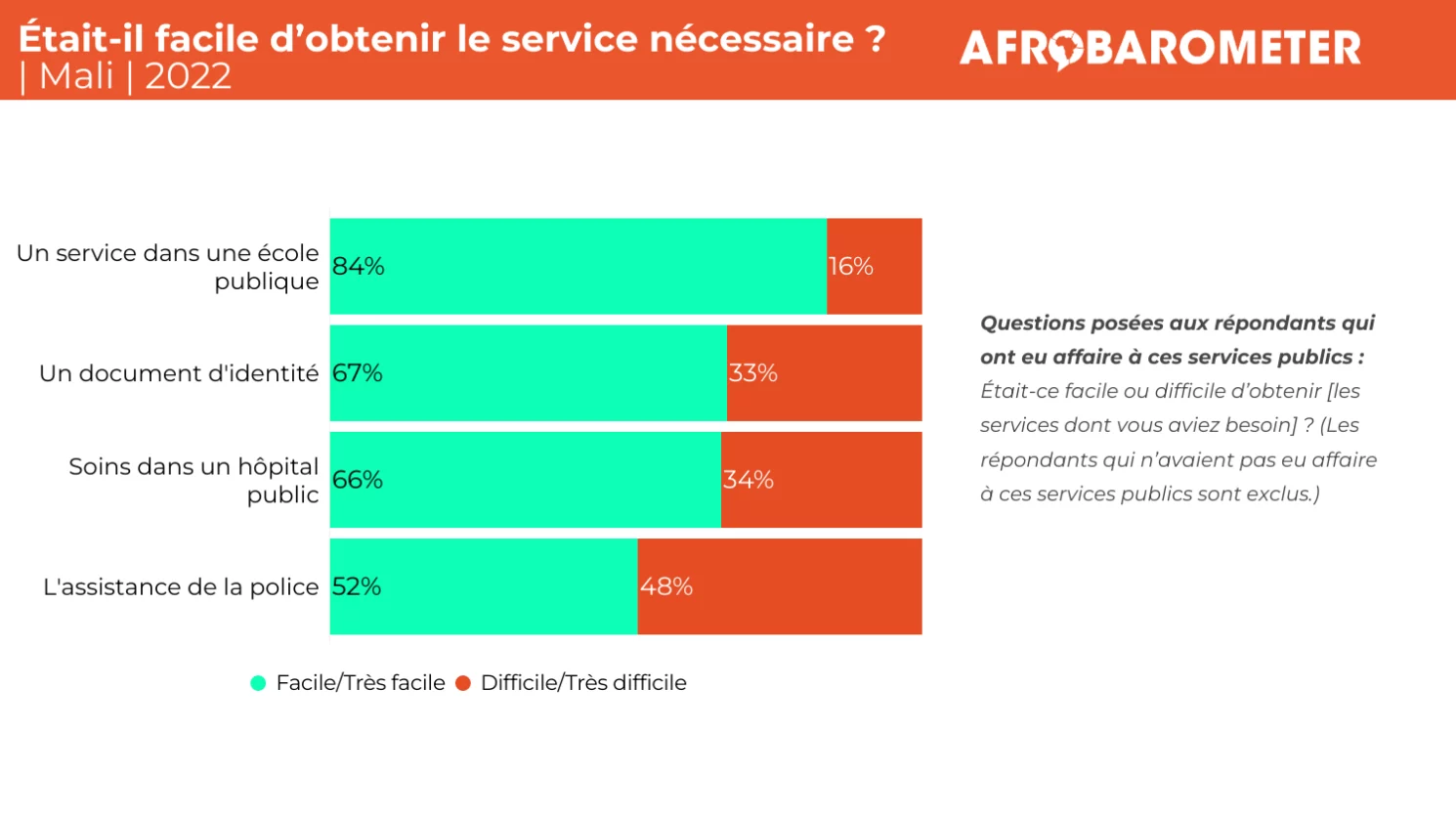
News release
L’accès à certains services publics au Mali reste facile malgré quelques irrégularités, selon les citoyens
4 Jan 2023
