


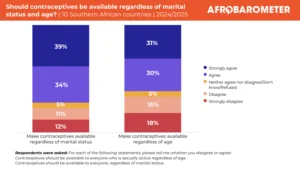
Promoting women’s health, including sexual and reproductive health and rights (SRHR), is key to the achievement of universal health coverage, gender equality, and health equity. Health is indispensable to a woman’s quality of life and facilitates other human rights, enabling full participation in economic, social, and political life (World Health Organization, n.d.). Sustainable Development Goals (SDGs) 3 and 5 speak directly to this through their mission to, respectively, ensure healthy lives and well-being for all and to advance gender equality (SIDA, 2021).
The story of SRHR in Southern Africa is a mixed bag of progress and challenges. On the progress front: The latest Southern African Development Community (SADC) scorecard, which tracks implementation of the SADC SRHR strategy (2019-2030) and gains toward SDGs related to health and gender equality, shows that adolescent births are down in 12 of the 16 member states, attributed largely to the introduction of sexuality education in schools. Other wins include declining HIV infection rates (although less impressively among adolescent girls and young women (AGYW)), reduced mother-to-child HIV transmission rates, and lower maternal mortality rates (SADC, 2026).
An ongoing challenge in the region is the provision of family-planning services: Half of SADC’s member states are failing to meet the contraceptive needs of AGYW (Muhammed, 2026). Additionally, most SADC countries do not consider abortion an essential health-care intervention, limiting access to safe and legal abortion services. While South Africa and Mozambique have pioneered legal frameworks for safe abortion, many women in the region continue to face legal, institutional, and social hurdles. For example, Zimbabwe and Botswana permit abortions only in cases of rape or incest or if the woman’s health is threatened (Gender Links, 2025). Estimates suggest that one in three unintended pregnancies in the SADC region are terminated, often under hazardous conditions due to a web of restrictive regulations (SADC Parliamentary Forum, 2025). And unsafe abortion is one of the primary causes of maternal deaths worldwide (Haworth, 2022).
Legal restrictions, gender inequality, poverty, stigma, and the unmet need for contraception combine to set the stage for limited access to, and uninformed decision making about, SRHR services, especially for AGYW (SADC Parliamentary Forum, 2025).
This dispatch examines public opinion in 10 Southern African countries on women’s bodily autonomy, sexuality education, continued schooling for pregnant girls and adolescentmothers, contraceptive access, and abortion based on the latest Afrobarometer survey round, conducted between January 2024 and September 2025.1
The findings reveal that large majorities of Southern Africans support women’s autonomy in decisions about marriage and childbearing, favour the teaching of sexuality education in schools, and – in most countries – support access to contraceptives regardless of marital status or age.
But opinions are mixed on the issue of abortion: While there is broad acceptance of pregnancy termination if the woman’s health or life is in danger, only half of citizens in the region consider abortion justifiable if the pregnancy is due to rape or incest. And there is strong opposition to abortion in cases where the woman lacks the financial muscle to take care of a child or does not want to have a child regardless of the reason.
Share
Language
English
Topics
Health, education, and social services
Keywords
HealthReproductive health
Regions
Southern Africa
Related content
News release
Majorities of Emaswati report going without medical care, disapprove of government’s performance on health
4 Nov 2025
Dispatch
AD755: Zambians laud government’s response to COVID-19 but believe resources lost to corruption
8 Jan 2024Working paper
WP154: The face of African infrastructure: Service availability and citizens’ demands
1 Aug 2015
